















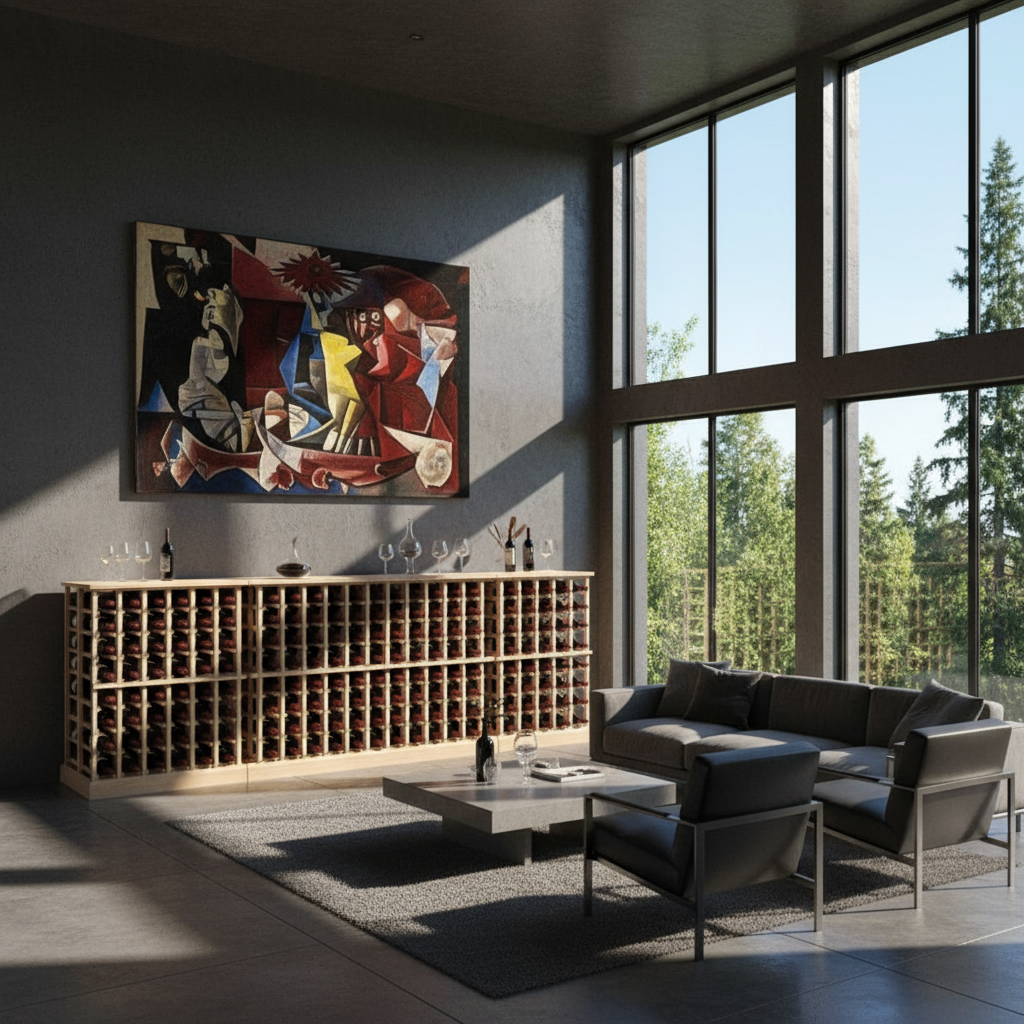
The question of rack material is where most collectors spend the most time when planning a wine storage setup, and understandably so. It is the most visible decision. It sets the aesthetic tone of the cellar and, to the untrained eye, looks like a purely stylistic choice. The reality is more nuanced.
Material determines how a rack performs in humidity. It determines whether the structure holds its integrity through years of temperature cycling. It shapes how well the rack absorbs or transmits the low-level vibration a climate-control system generates. And it determines whether the storage solution can grow and adapt alongside a collection, or whether it is fixed at the point of installation.
Aesthetics matter. But they are the second consideration, not the first. A rack in a dedicated, climate-stable cellar in a traditional installation calls for a different answer than one in a high-humidity coastal environment, a city condo with seasonal temperature swings, or a collection being built incrementally across several rooms. The right material is the one that performs reliably in the specific environment where it will live.
This post covers each material category in the depth the decision deserves: what it is built from, how it performs across the conditions collectors actually face, where it excels, and where it falls short. For a broader look at configuration formats, capacity planning, and build quality markers, the companion guide on what to look for in a wine rack covers those variables in full.
Wood: The Traditional Material, Properly Understood
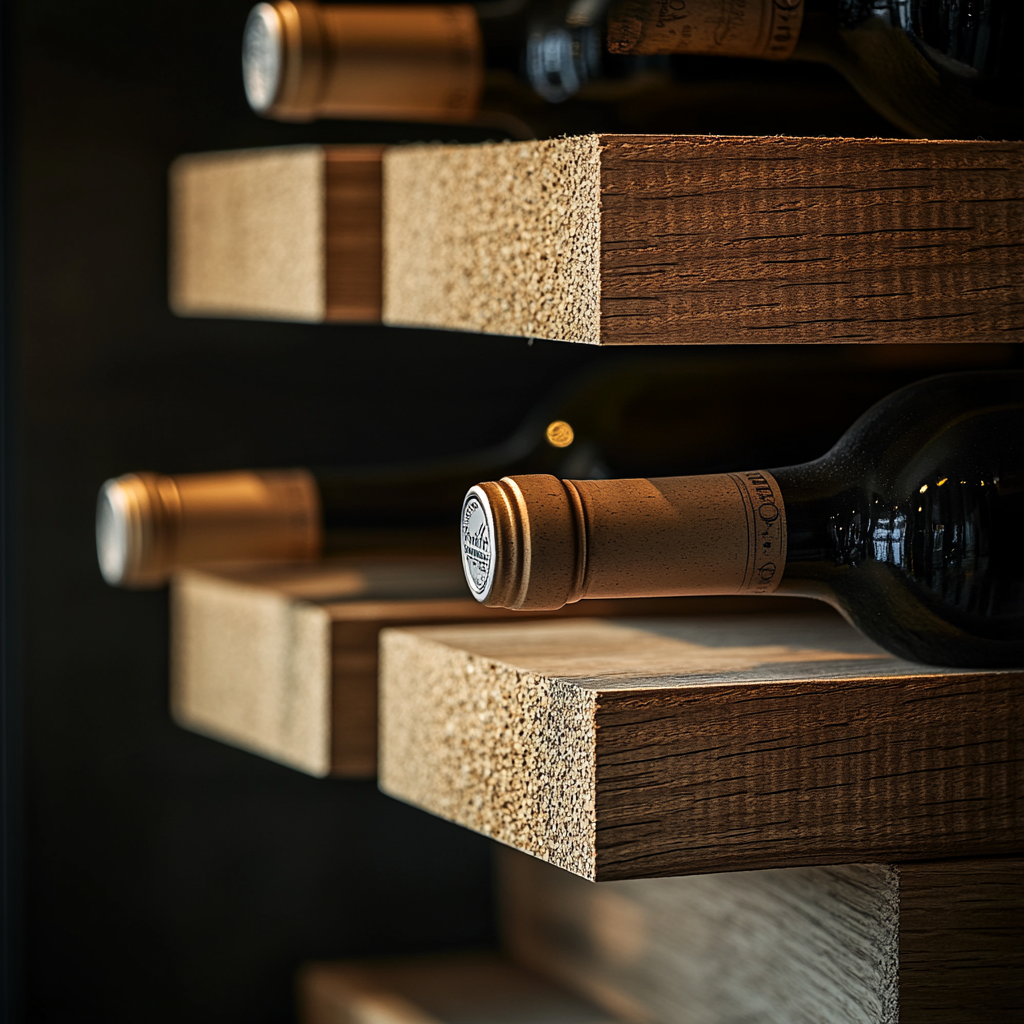
Wood has been the default material for wine racking for centuries, and for good reason. In the right environment, a well-built wooden rack is durable, functional, and visually appropriate in ways that no other material quite matches.
The case for wood begins with its natural properties. Wood is a relatively poor conductor of temperature, which means it does not amplify ambient heat or cold the way a metal rack can. In a stable cellar, this works in the wine's favour. It also has some natural acoustic absorption, which reduces the transmission of low-frequency vibration, though the practical significance of this in a properly built cellar is modest compared to the humidity question.
The more important consideration is what the wood is made from, and how it is assembled. Not all wooden wine racks are equivalent. The species, how it has been dried and treated, and the joinery method used in construction all determine whether the rack performs reliably over years of sustained load, or whether it loosens, warps, and fails earlier than it should.
Redwood vs. Hardwood: Two Different Propositions
California Redwood has been a foundational choice for wine rack construction for generations, valued for its natural resistance to moisture, dimensional stability, and clean workability. Redwood holds its shape well across moderate humidity ranges and does not develop the mould susceptibility that cheaper softwoods can. Rosehill's modular redwood kit racks draw on this tradition: a well-priced, straightforward wood option built from all-heart California redwood that assembles without requiring professional installation and performs reliably in managed cellar environments.
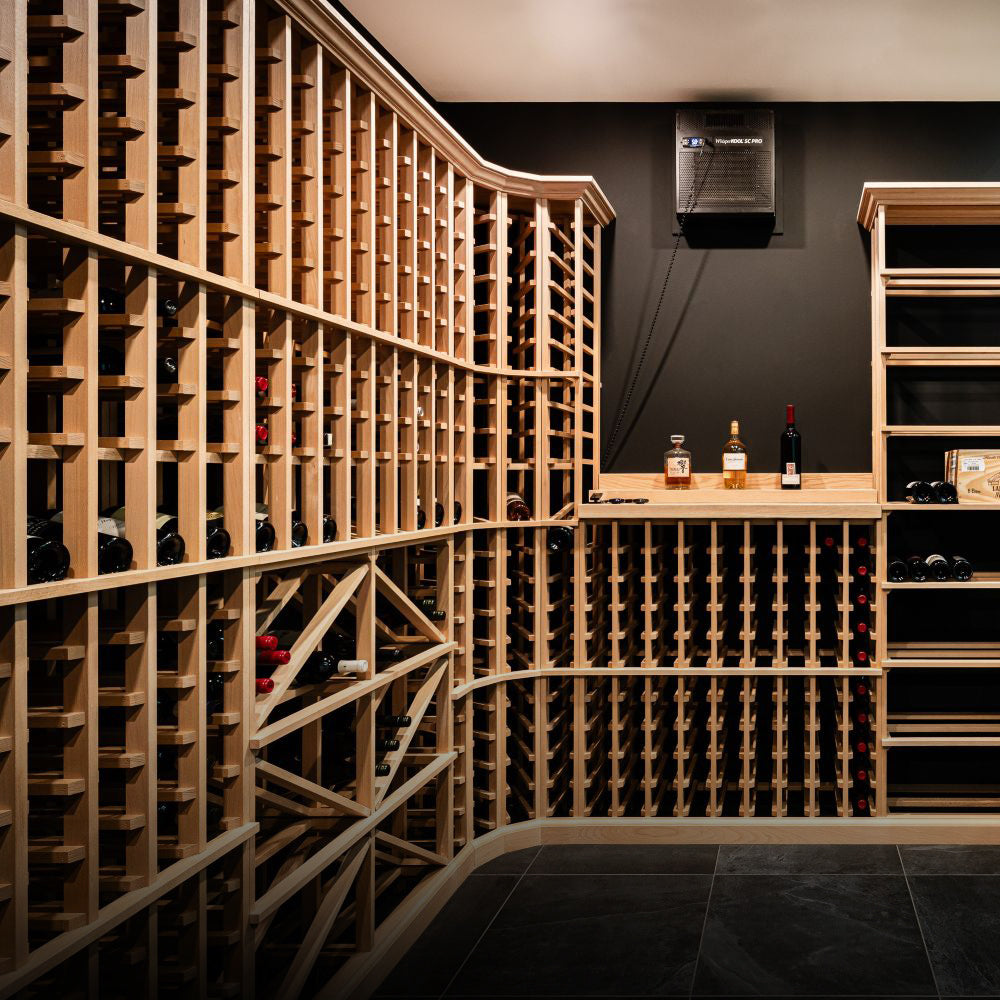
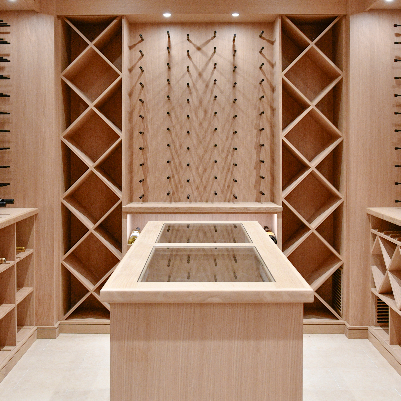
For collectors who want something more substantial, hardwood racking raises the performance and aesthetic ceiling. Premium hardwoods such as European Beech, Toasted Maple, and Sapele offer greater structural density, tighter grain, and higher resistance to denting and wear over time. These are the woods behind Premier Cru Wine Racks, Rosehill's house brand racking. A hardwood rack in a temperature and humidity-stable cellar will outlast most alternatives and age with a natural warmth that engineered wood or softwood cannot replicate.
Joinery: The Variable Most Buyers Overlook
Wood species quality only translates into rack quality through proper construction. Notched joints, pre-attached cleats, and mortise-and-tenon construction produce racks that stay rigid under the sustained weight of full bottles. Racks assembled primarily with staples, thin nails, or light adhesive loosen over time, particularly as the wood moves through seasonal humidity changes. Premier Cru's construction uses notched joints and pre-attached cleats specifically to produce a stable, load-bearing structure that integrates cleanly once installed, with decorative crown and base mouldings that complete the finished look.
Where Wood Struggles
Wood's vulnerability is humidity instability. In environments where relative humidity fluctuates significantly, untreated or poorly finished wood swells and contracts with each cycle. Over time, that movement stresses the joinery, and the cumulative effect is a rack that loosens and gradually loses its structural integrity. In high-humidity storage environments, such as Florida cellars, coastal spaces, or any room where moisture management is variable, wood racks require either a particularly stable, managed humidity range or more attention than metal alternatives over the long term.
This is not a reason to avoid wood. It is a reason to match the choice to the conditions. A well-built hardwood rack in a managed, purpose-built residential cellar is a long-term investment that improves with age. The same rack in an uncontrolled environment will underperform a well-specified metal alternative. Proper storage conditions, including the temperature stability that prevents those humidity swings in the first place, are covered in the guide on wine storage temperature and how it relates to cellar conditions.
Wood is at its best when the environment is at its best: stable, managed, and purpose-built for wine.

Metal: Performance Across a Wider Range of Conditions
Modern metal wine racking has evolved well beyond the wrought-iron utility rack. Today it spans the full aesthetic range from traditional to contemporary, and its functional advantages over wood are meaningful in any environment where humidity and temperature are variable.
Why Metal Handles Moisture Better
Metal does not absorb or release moisture the way wood does. A properly finished powder-coated steel rack holds its dimensions and structural integrity whether the humidity in the cellar sits at 50 percent or climbs through seasonal fluctuation. It does not swell, contract, or develop the organic growth that can occur in wood under sustained moisture exposure. For collectors in climates with meaningful humidity variation, including the year-round heat and moisture of a Florida coastal home or the seasonal extremes of a Toronto basement, metal racking removes one variable from the performance equation entirely.
The critical qualifier here is finish quality. A metal rack with thin or poorly applied powder coating will develop surface rust over time in a humid cellar environment. Properly finished steel, where the coating is applied in an even, durable layer and cured to a hard finish, resists corrosion through years of temperature and humidity cycling. When evaluating metal racking, the quality of the finish matters as much as the thickness of the underlying steel.
Modular Metal: The Architecture for Growing Collections
The structural advantage of modular metal racking is adaptability. Individual panels, columns, or sections can be added as the collection grows, reconfigured as the space changes, and relocated if necessary. For collectors building incrementally, for those who are not yet certain of their long-term storage footprint, or for anyone who wants to avoid the permanence of a custom installation until the layout is fully settled, modular metal is the practical architecture.
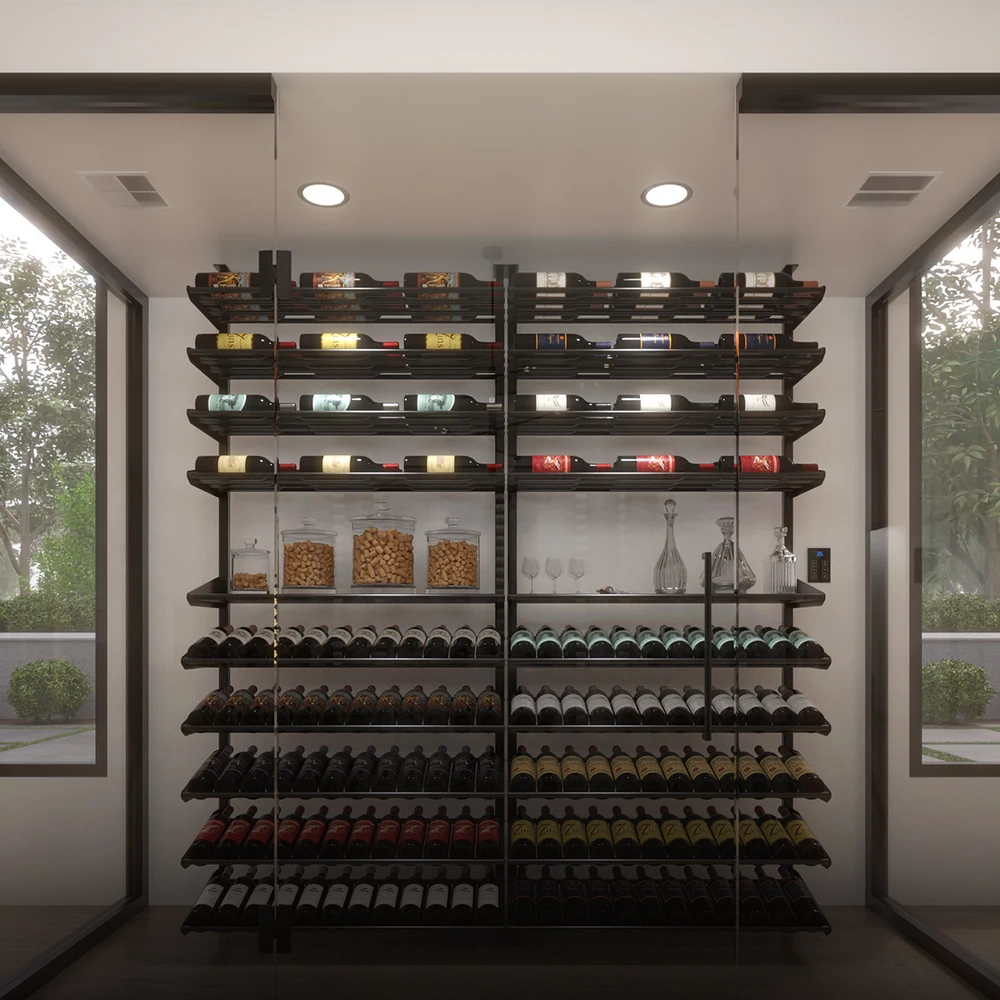
Rosehill's metal wine rack collection includes both traditional modular panel formats and contemporary wall-mounted systems. The latter include label-forward designs that hold bottles with the label facing outward, giving collectors visual access to inventory without pulling bottles to check them. Wall-mounted metal systems also take advantage of vertical space efficiently, which matters in any room where floor area is at a premium.
Aesthetic Range in Metal
One of the underappreciated qualities of metal racking is how wide its aesthetic range actually is. Heavier wrought-iron and traditional dark finishes suit a classic cellar aesthetic. Powder-coated steel in matte black, gunmetal, or dark metallic finishes integrates naturally into contemporary interiors. Minimal open-frame systems disappear into the architecture of a modern wine room, making the collection itself the visual feature rather than the racking structure. The visual character of metal racking is largely a function of finish and profile rather than the material itself, which gives collectors considerable flexibility to match the racking to the space without compromising the functional case for metal.
Metal racking is not the modern compromise. In variable environments, it is the more reliable technical choice.
Acrylic and Contemporary Formats: When the Display Is the Point
Alongside traditional wood and metal, a third category has become a significant part of the racking conversation: contemporary systems built around acrylic components, minimal peg-based formats, and open-face display architecture. These systems share the humidity resistance of metal components but occupy a distinct niche that is worth understanding clearly before committing to the investment.
What Acrylic Racking Actually Delivers
Acrylic appears most commonly in peg-based systems, where individual clear or tinted pegs support each bottle at the neck and base, holding it at an angle that displays the label. From a distance, the bottles appear to float against the wall or panel without visible support. The visual effect is dramatic, and for collectors who want wine storage to function as a design statement in a living space or dedicated tasting room, the look is genuinely distinct from anything wood or conventional metal delivers.
Functionally, acrylic pegs perform comparably to metal in terms of humidity resistance and bottle support. The format inherently displays bottles label-forward, which is a practical advantage for collectors managing large inventories. Where acrylic diverges from metal is in cost per bottle: peg-based acrylic systems carry a higher price point than equivalent metal panel racking, and the premium is almost entirely attributable to the visual effect rather than functional performance.
Peg-Based Metal: The Bridge Format
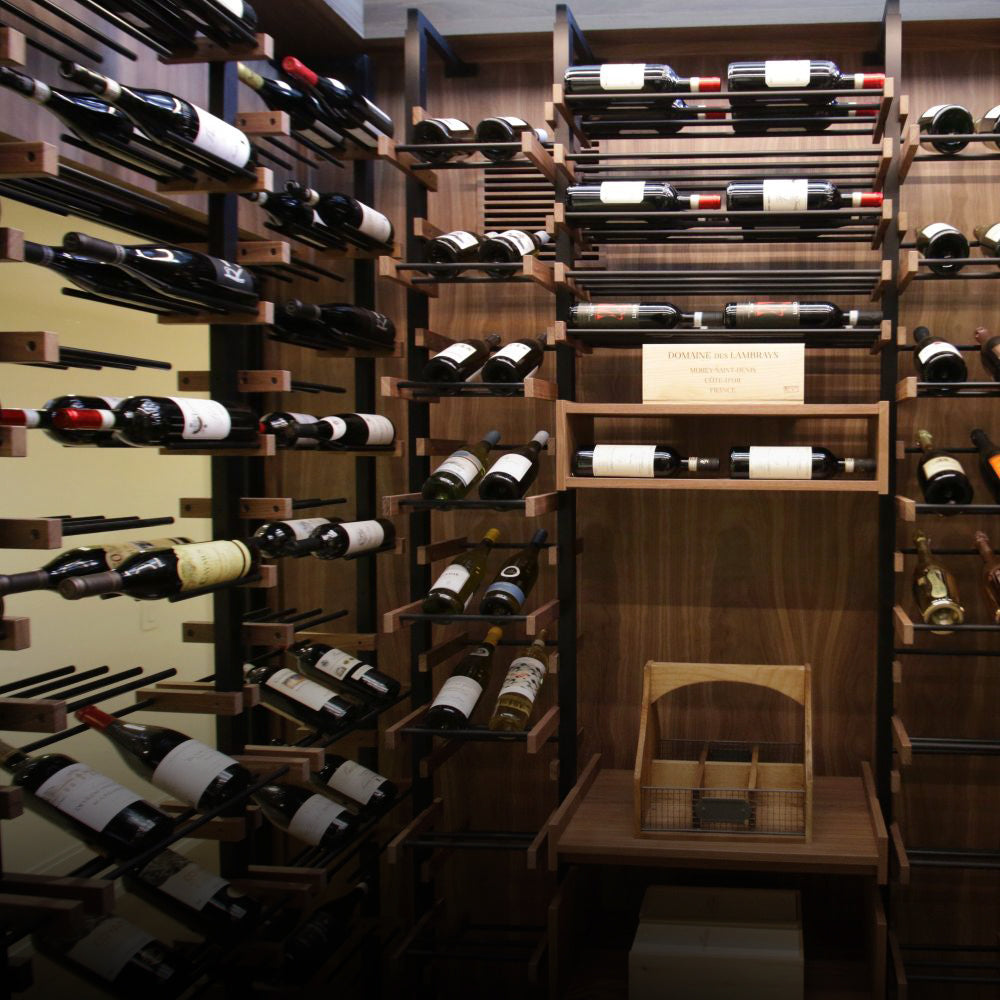
Peg-based systems are also available in metal rather than acrylic, offering the same label-forward display with greater visual weight and the full durability profile of quality steel. Rosehill's wall-mounted metal rack range includes peg systems alongside panel and column formats, giving collectors the flexibility to choose between a more structural metal aesthetic and a lighter, more minimal peg configuration within the same functional category. For collectors who want the visual clarity of a label-forward display without the full acrylic premium, metal peg systems offer a practical middle point.
When Contemporary Formats Earn Their Cost
A peg-based or acrylic racking system earns its cost when the installation is in a space where it will be seen and where visual impact is part of what the collection communicates: a wine room with glass doors visible from a living area, a dining room feature wall, a tasting room designed for hospitality, or a modern kitchen where bottles are part of the room's design composition. For back-of-house storage, aging stock held for the long term, or utility racking in a cellar that no guest ever enters, the visual premium does not change the wine's trajectory. Standard modular metal at a lower cost per bottle delivers the same functional result.
The question is not whether acrylic and contemporary formats work. It is whether the design investment is where the space and the collection actually call for it.
Matching Material to Environment: The Test That Matters
The practical way to apply these considerations is to evaluate the specific conditions of the storage environment before making a material decision. Three questions define most of what needs to be answered.
The Humidity Question
If the cellar or wine room runs at stable, controlled humidity, wood is a fully viable option. Well-built hardwood racking from a quality manufacturer, properly installed in a managed environment, will perform reliably for decades. If humidity fluctuates significantly, or if the storage space is in a climate where moisture management is variable and not purpose-built, metal is the lower-maintenance choice. This distinction matters most in Florida, coastal environments, and any storage situation where the temperature and humidity control is not monitored and maintained consistently.
The Permanence Question
If the racking is being installed in a finished, long-term space where the layout is settled, integrated wood or fixed metal racking makes sense. If the space is still evolving, the collection is growing, or the commitment to a permanent layout has not yet been made, modular metal racking is the rational choice. It does not foreclose future options. The ability to add panels, shift sections, or relocate the system entirely is not a minor convenience: it is a meaningful hedge against the near-certainty that the collection will grow beyond what today's layout anticipates.
The Aesthetic Question
Only after the functional questions are settled does aesthetic preference become the primary driver. At that point, the choice between a warm, finished hardwood installation, a clean and contemporary metal system, or a design-forward peg-based or acrylic format reflects how the collector wants to inhabit and experience the space. None of these choices is wrong. They serve different collections, different rooms, and different relationships with wine.
For collectors working through not just material but also configuration formats, capacity planning, and the specifics of freestanding versus integrated racking, the complete wine rack buying guide covers those variables in full. For collectors thinking about the wines themselves and the storage windows that make the right racking decision consequential, the guide on how long you can store wine brings the conversation full circle.

Quick Reference: Wood, Metal, and Acrylic at a Glance
Wood (redwood kit racks and Premier Cru hardwood racking):
Best environment: stable, humidity-controlled cellars and wine rooms. Structural character: warm, furniture-grade aesthetic; natural cellar feel. Build quality marker: hardwood species; notched joint or mortise-and-tenon construction. Limitation: susceptible to humidity fluctuation; harder to reconfigure once installed. Best for: permanent, finished cellar installations where conditions are managed.
Metal (powder-coated steel, wall-mounted systems, modular panels):
Best environment: variable humidity; climates with seasonal or daily moisture swings. Structural character: holds dimensions regardless of humidity; modular systems expand as collections grow. Build quality marker: quality and thickness of powder coating or finish; gauge of underlying steel. Limitation: warmth of aesthetic is lower than premium hardwood in a traditional cellar context. Best for: growing collections, variable environments, and contemporary spaces.
Acrylic and peg-based contemporary formats:
Best environment: display-forward spaces and wine rooms designed for hospitality or visual impact. Structural character: dramatic label-forward presentation; equivalent humidity resistance to metal. Build quality marker: finish quality, peg material, and mounting system. Limitation: higher cost per bottle; the premium is visual, not functional. Best for: design-statement installations where the wine room is part of the living space.
The right material is not the most expensive one. It is the one that performs reliably in the conditions where the collection actually lives.
Ready to Find the Right Racking for Your Space?
Rosehill carries the full range: Premier Cru hardwood racking for collectors building permanent, finished cellars; modular redwood kit racks for a well-priced, accessible wood option; metal systems spanning traditional panel formats to contemporary wall-mounted displays; and peg-based and acrylic formats for collectors who want storage to function as a design statement. Whatever the material, the configuration, and the environment, the right match exists.
Browse our full wine racks collection online, or contact the team directly for a material and configuration recommendation built around your specific space and collection.