














Outdoor entertaining in Florida is genuinely different from anywhere else in North America. The climate is generous for most of the year, and Floridians use that generosity: lanais become living rooms, pool decks become dining rooms, and outdoor kitchens have become a standard feature of serious homes rather than an occasional upgrade. Wine belongs in those spaces. The problem is that the wrong wine fridge placed outside will fail, quietly at first and then all at once, usually during the hottest stretch of a summer you were actually looking forward to.
Florida's heat, humidity, and coastal air chemistry create conditions that disqualify most standard wine coolers from outdoor use entirely. Understanding why requires looking past the spec sheet to the engineering decisions that determine whether a unit is built to live outdoors or simply built to sit in a conditioned space. At Rosehill Wine Cellars, we've had this conversation with collectors across Florida for over thirty years. This guide covers what separates a true outdoor-rated wine fridge from an indoor unit pushed outside, which factors matter most for Florida specifically, and what to look for before you invest.
An outdoor wine fridge isn't a different category in name only. In Florida's climate, it's a different product entirely.
Why Florida Demands More From an Outdoor Wine Fridge
Standard wine coolers are designed to operate within a controlled indoor environment. Most are rated for ambient temperatures between roughly 60°F and 80°F. Step outside in Florida between June and September, and ambient temperatures on a covered lanai regularly exceed that ceiling. On an uncovered deck or in direct afternoon sun, a dark-coloured unit can face surface temperatures considerably higher. A compressor working against 95°F ambient heat is under enormous strain. A unit not engineered for that condition will overheat, run continuously without reaching its set point, or shut down on a thermal protection cycle precisely when your guests arrive.
Heat is only one part of the challenge. Florida's relative humidity routinely climbs above 80% during summer months, and coastal properties layer marine air and airborne salt onto that baseline. Salt is corrosive to metal, electronics, and seals alike. A unit with exposed mild steel components, standard electrical connectors, or a door gasket designed for low-humidity climates will degrade faster than any warranty period would suggest. Factor in poolside chlorine vapour, seasonal rain events, and the occasional spray from a pressure washer cleaning the deck, and the demands on an outdoor-rated unit become clear.
UV exposure rounds out the picture. Florida receives more ultraviolet radiation than almost any other market in North America. Standard glass on indoor wine fridges is not treated for UV resistance. Set one in a position with direct sun exposure and you are actively damaging the wine inside, regardless of whether the thermostat is working perfectly.
What "Outdoor-Rated" Actually Means
The term outdoor-rated gets used loosely in product marketing. For a wine fridge to genuinely qualify as outdoor-appropriate in a Florida climate, look for a specific set of engineering characteristics rather than taking category labelling at face value.
Ambient Temperature Rating
This is the single most important specification for Florida use. Confirm the unit is rated to operate reliably at ambient temperatures of 90°F or higher. Some premium outdoor units carry ratings to 110°F, which provides meaningful headroom for uncovered placements or particularly intense summers. If a product listing doesn't publish an ambient operating range, assume it is not rated for outdoor use.
Stainless Steel Grade
Not all stainless steel performs equally in salt-rich coastal environments. Grade 304 stainless, the most common in appliances, provides solid corrosion resistance in most conditions. Properties within a mile or two of the Gulf of Mexico or the Atlantic, where marine air concentration is highest, benefit from grade 316 stainless, which contains molybdenum and carries significantly better resistance to chloride-based corrosion. If the product listing doesn't specify stainless grade and you are in a coastal community, it is worth asking before you purchase.
UV-Resistant Glass
Outdoor-rated units designed for wine storage typically incorporate low-emissivity or UV-blocking glass that filters harmful ultraviolet light before it reaches the bottles inside. This is non-negotiable if any portion of the unit will receive direct sun exposure, even for part of the day.
Sealed and Protected Electronics
Look for moisture-resistant wiring, sealed control panels, and connectors rated for humid environments. On a covered lanai this matters less than on an open deck, but Florida's humidity means the distinction between indoor and covered outdoor is smaller than it appears.
Compressor-Based Cooling
Thermoelectric wine coolers, which use a solid-state cooling element rather than a compressor, are efficient and vibration-free in stable indoor environments. They lose efficiency sharply as ambient temperature rises and are not suited for Florida outdoor conditions. A compressor-based unit is the right architecture for any outdoor placement in a warm climate. For context on how ambient conditions relate to storage performance more broadly, our earlier post on wine storage temperature vs. serving temperature covers the science in detail.
Perlick: The Benchmark for Outdoor Refrigeration
Among the brands we carry at Rosehill, Perlick has the strongest reputation in outdoor-rated refrigeration. Their outdoor series is purpose-built for the demands of alfresco use: heavy-gauge stainless construction, compressor-based cooling calibrated for high-ambient performance, integrated door locks that resist both the elements and uninvited guests, and interior configurations designed for practical entertaining use rather than maximized theoretical bottle counts.
Perlick's outdoor wine columns have become a fixture in higher-end Florida outdoor kitchen builds, and for good reason. They are designed to perform as reliably on a Naples lanai in August as they would in a temperature-controlled showroom. The brand's track record in commercial bar and hospitality settings translates directly to residential outdoor kitchens where performance under sustained heat and humidity is the baseline expectation, not an edge case.
For collectors investing in a serious outdoor entertaining space, a Perlick outdoor wine column is one of the few products on the market we recommend without qualification for Florida conditions.

Placement Decisions That Affect Performance
Even the best outdoor-rated wine fridge will underperform if the placement isn't thought through. Several factors specific to Florida properties are worth addressing before the unit goes in.
Covered Versus Uncovered
A covered lanai or outdoor kitchen with a solid roof is the ideal placement for an outdoor wine fridge. It eliminates direct rain exposure, reduces UV load, and keeps the ambient temperature meaningfully lower than an unshaded deck. If your placement is fully exposed to the sky, the requirements on the unit are significantly higher and the list of appropriate products narrows considerably.
Ventilation Clearance
Built-in outdoor wine fridges require front ventilation to function correctly. Confirm the unit's ventilation direction before specifying it for a cabinetry run or under-counter slot. Restricting airflow in an already warm outdoor environment compounds the thermal challenge the compressor is managing. For a broader look at how ventilation affects wine fridge performance, our guide to built-in vs. freestanding wine fridges covers the principle in detail.
Proximity to the Pool
Pools introduce two variables worth noting: chlorine vapour, which is corrosive to certain metals and electronics, and splashing during active use. Placing an outdoor wine fridge within a few feet of the pool edge without a screen or cabinet surround puts it in a more aggressive environment than a standard outdoor placement. If the aesthetic calls for pool-adjacent positioning, confirm the unit's moisture and chemical resistance before committing to the location.
Sun Exposure and Orientation
West-facing placements in Florida take the full force of afternoon sun from roughly 1pm onward, which is also the hottest part of the day. Even on a covered lanai, radiant heat from adjacent surfaces can raise the microclimate around the unit. Where you have a choice, a north or east-facing placement will put less thermal demand on the fridge and extend its service life.
Sizing for Florida Entertaining
Capacity decisions for an outdoor wine fridge follow different logic than sizing a unit for a wine room or kitchen. The outdoor fridge is typically serving an event rather than aging a collection. That shifts the calculation toward accessibility and throughput rather than maximum bottle count.
For most Florida entertaining contexts, a unit in the 24- to 48-bottle range covers the typical dinner party or pool gathering comfortably, with enough variety to serve both reds and whites at the right temperatures. A single-zone unit set to around 55°F works well as a holding temperature that suits most wines without requiring constant adjustment, though a dual-zone configuration gives you more flexibility if you are moving regularly between Champagne service temperatures and red wines. Our guide on how to choose the right wine fridge size covers capacity decisions in full if you are working through a larger build.
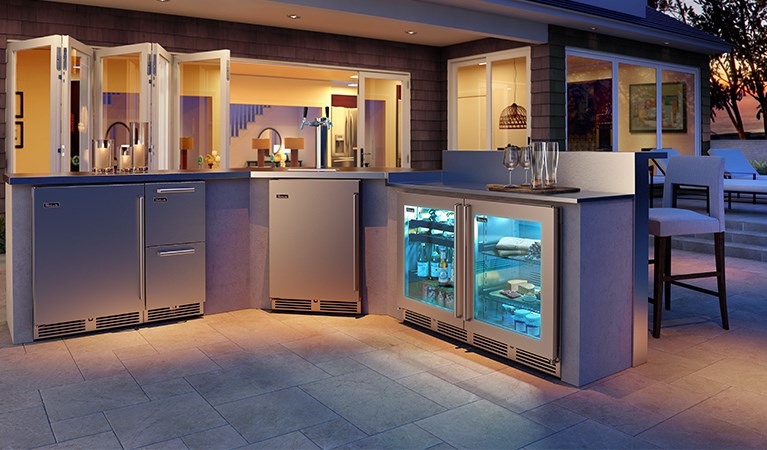
For larger outdoor entertaining spaces or homes designed for regular hosting, a full wine column integrated into the outdoor kitchen cabinetry provides considerably more capacity and a more finished aesthetic than a standalone undercounter unit. Some collectors use a combination: a full wine column for holding inventory and a smaller dedicated unit set to serving temperature for the evening's selections.
The Outdoor Kitchen Context
Florida's outdoor kitchen culture has elevated the expectations around what outdoor entertaining looks like, and wine storage has followed. Integrated wine columns now appear alongside refrigerator drawers, ice makers, and grilling stations in outdoor kitchens designed for serious entertaining. The visual coherence of a properly specified outdoor wine fridge, built into cabinetry rather than standing alone, signals the same intentionality as every other element of a well-designed outdoor space.
For collectors building or renovating outdoor kitchens, the wine storage component benefits from the same specification discipline as the rest of the project: understand the environment, match the product to its demands, and invest in the quality tier that will perform correctly for the long term. Our team works regularly with Florida clients on builds at this level, from the design stage through product specification. If you are working on a project in Naples, Sarasota, or anywhere on the Gulf or Atlantic coast, our Naples showroom is the right starting point.
Ready to Specify Your Outdoor Wine Fridge?
Florida outdoor entertaining demands products that are genuinely built for the conditions, not indoor units dressed up in outdoor language. Browse our full range of wine coolers and refrigeration, including Perlick's outdoor series, on our website. Or contact the Rosehill team directly to talk through your project.
If you are in the early stages of an outdoor kitchen build or a lanai renovation and want to get the wine storage right from the start, we are well placed to help. We have done this across Florida many times. Getting the specification right before the cabinetry goes in is considerably easier than correcting it afterward.
Rosehill Wine Cellars