
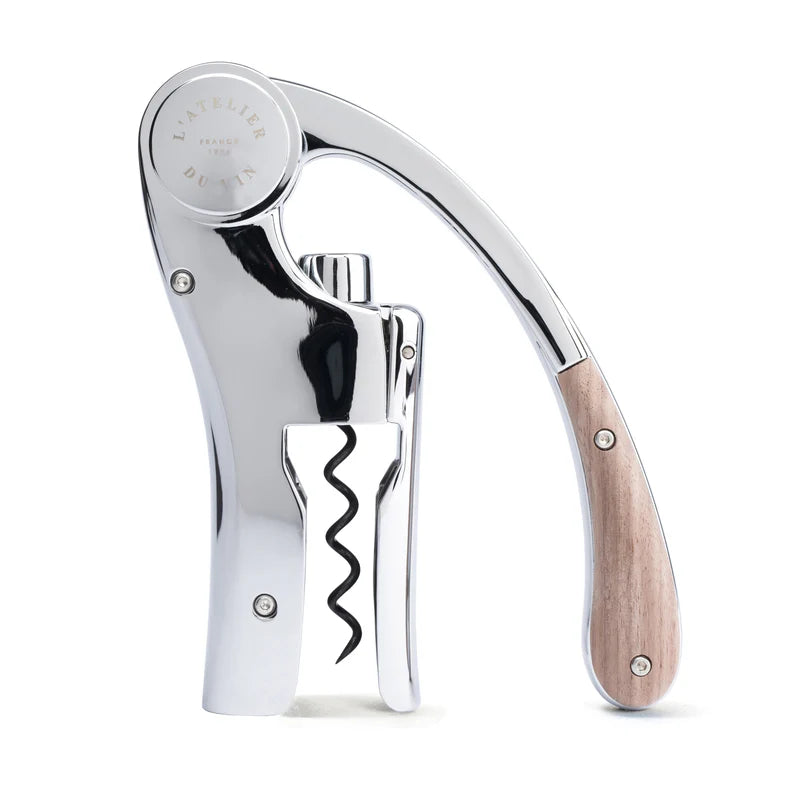










An extra hinge does not automatically mean less effort. The main difference in waiter’s corkscrew double-lever vs. single-lever mechanical advantage is how the cork is lifted. Both designs use leverage, but a double-hinge model raises the cork in two stages, helping you keep the pull straighter as it comes out.
If you’ve heard “wine key” and “waiter’s corkscrew” used interchangeably, they generally refer to the same compact opener: a handle, a spiral, and a lever. The hinge count is the detail that changes the opening motion, not the basic purpose of the tool.
This guide explains how each hinge style works, what leverage can and cannot tell you about effort, and which practical features matter when opening bottles regularly. A side-by-side comparison and simple decision guide can help you choose a corkscrew that feels controlled and comfortable to use.
Key Takeaways
- A wine key and a waiter’s corkscrew generally refer to the same compact opener; the hinge design changes how the cork is lifted.
- A double-hinge model lifts the cork in stages, while a single-hinge model uses one lever point for the pull.
- Choose based on the opening motion and control that feel comfortable, not on hinge count alone.
- For a smoother extraction, center the spiral, rest the lever securely on the bottle lip, and keep the cork as vertical as possible.
- If you open bottles often, consider how the corkscrew’s leverage and handling suit your routine.
What Features Make a Good Corkscrew?
A useful corkscrew gives the worm a secure grip and lets you control the cork as it rises. Centered placement, a stable lever, and a straight pull matter more than speed.
Controlled Cork Extraction
Place the worm near the cork’s center and turn it in without forcing it sideways. Rest the lever securely on the bottle lip, then lift with steady pressure. Keeping the cork vertical helps limit bending stress, which can contribute to breakage where the dry top meets the wet bottom.
Worm dimensions affect how the tool engages the cork. Length determines how deeply the spiral reaches, and excessive depth can pierce through the cork. Thickness affects how the worm enters and grips, while its coating influences friction during insertion and removal.
Two-Motion Cork Removal
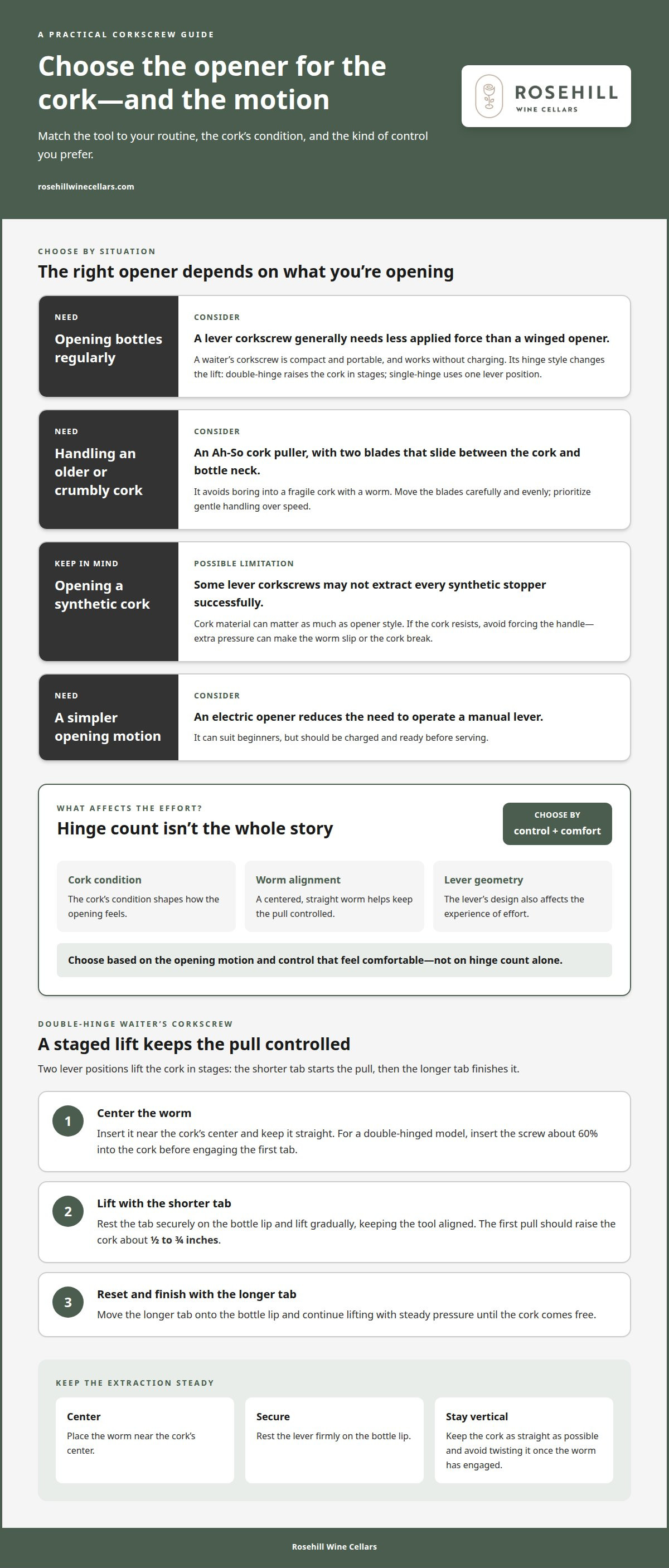
A double-hinged waiter’s corkscrew divides extraction into two controlled lifts. Use the shorter tab for the first pull, then reposition the longer tab to finish. A single-hinge corkscrew uses one lever position and may draw the cork at an angle as it rises.
- Insert the worm near the cork’s center, keeping it straight.
- Set the first tab on the bottle lip and lift gradually.
- Move to the second tab and continue until the cork comes free.
With a double-hinged model, the first pull should raise the cork about ½ to ¾ inches. This partial lift creates room to reposition the lever without wrenching the cork sideways. Keep one hand steady on the bottle neck, and avoid twisting the cork once the worm has engaged.
An Ah-So cork puller is a different option for older corks. Its two blades slide between the cork and bottle neck instead of boring into the cork with a worm. This avoids turning a fragile cork with a spiral, but the blades need careful, even movement as they slide alongside it.
| Opener | Engagement | Extraction motion | Useful distinction |
|---|---|---|---|
| Double-hinge waiter’s corkscrew | Worm enters cork | Two lever positions | Staged lift |
| Single-hinge waiter’s corkscrew | Worm enters cork | One lever position | Direct pull |
| Ah-So cork puller | Two blades slide beside cork | Gentle turning and pulling | Suited to older corks |
Choose a double-hinge model for a staged lift, a single-hinge model for a direct lever action, or an Ah-So for an older cork.
Choosing a corkscrew for frequent opening
For regular bottle opening, choose an opener that gives you controlled leverage and feels comfortable through repeated use. A lever corkscrew generally requires less applied force than a winged model, making it practical when opening several bottles during a meal or service.
A waiter’s corkscrew is compact and portable, but its hinge design affects how each pull feels. A double-hinge model divides the lift into stages, while a single-hinge model pulls from one lever position. Neither hinge count alone determines effort. The cork’s condition, worm alignment, and lever geometry all shape the experience.
For natural cork, a waiter’s corkscrew offers a direct, controlled way to open a wine bottle. With synthetic corks, some lever corkscrews may not work successfully, so the cork material can matter as much as the opener. If the cork resists, avoid forcing the handle: extra pressure can make the worm slip or the cork break.
Older or crumbly corks call for a gentler approach. An Ah-So cork puller is preferred for older corks because its blades slide between the cork and bottle neck rather than drilling into the cork. It can be a useful alternative when a worm might tear a fragile stopper. With a delicate cork, prioritize careful handling over speed.
An electric opener suits beginners and anyone seeking a simpler opening motion. It reduces the need to operate a manual lever, but should be charged and ready before serving. A waiter’s corkscrew, by contrast, fits in a pocket and works without charging, which is useful when portability matters.
- Frequent opening: Consider a lever corkscrew to reduce manual effort compared with a winged opener.
- Older or fragile cork: Choose an Ah-So to work between the cork and bottle neck.
- Synthetic cork: Remember that some lever designs may not extract every synthetic stopper successfully.
- Simple operation: An electric opener can suit beginners, provided it is charged.
For routine use, match the opener to the corks you encounter and the motion you prefer. A waiter’s corkscrew balances portability with manual control, while an Ah-So addresses older corks and an electric model simplifies the action. Explore premium corkscrew options as you consider which style best suits your opening habits.
Double-lever waiter’s corkscrew operation
A double-lever waiter’s corkscrew uses two contact points to lift a cork in stages. The first tab raises it partway; the longer tab completes the pull. This differs from a winged corkscrew, whose side arms rise as the worm turns into the cork. Both designs use leverage, but their hand motions and contact points differ.
Begin with the foil removed and the bottle steady on a firm surface. Place the worm near the cork’s center and turn it into the cork, leaving enough of the spiral outside to avoid pushing through the bottom. For a double-hinged model, insert the screw about 60% into the cork before engaging the first tab.
- Set the shorter tab securely on the bottle lip.
- Raise the handle to lift the cork partway, keeping the tool aligned.
- Reset the longer tab on the lip and lift again to remove the cork.
The first pull should raise the cork about ½ to ¾ inches from the bottle. This partial lift gives the second tab room to engage. Continue with steady pressure rather than jerking the handle, which can tilt the cork or strain the worm. Keep the bottle stable throughout both motions.
A winged corkscrew works differently. Turn its central worm into the cork, and its two arms rise. Press both arms down together to draw the cork out. This familiar motion can feel straightforward, though the effort can vary by opener and cork. A waiter’s corkscrew may suit someone who prefers a controlled, staged lift.
Single- or double-lever construction alone does not determine a fixed price difference. Materials, finish, and overall build influence the price, so hinge count by itself does not establish which model costs more.
Mechanical advantage depends on the distances from the fulcrum where input and output forces act, according to the Wikimedia Foundation. In practical terms, the lever’s shape and where it rests affect how your effort transfers to the cork. A second hinge changes the lifting sequence, but does not guarantee that every double-lever opener requires less force.
Choose according to both handling preference and mechanism. If you want a compact tool and a staged lift, a double-lever waiter’s corkscrew offers both. If you prefer to press two rising arms after turning the worm, a winged corkscrew provides that motion. Practising the sequence with an empty bottle can help you learn where each lever rests before opening wine.
Double-hinge versus single-hinge waiter’s corkscrews
Double-hinge models lift the cork in two stages, while single-hinge models use one fulcrum. Neither design is inherently more durable. Construction and how the joints and worm handle repeated use matter more than hinge count alone.
Double-Hinge Waiter’s Corkscrews
A double-hinge corkscrew gives you two lever positions as the cork rises. The first lift raises the cork, and the second continues extraction while helping keep the pull straight. This staged motion can feel more controlled as the cork clears the bottle neck, but it does not guarantee less effort or a longer life than a single-hinge tool.
Single-Hinge Waiter’s Corkscrews
A single-hinge model uses one contact point on the bottle lip. As the cork rises, the final pull may bring it out at an angle, unlike a double hinge’s two-stage lift. Insert the screw into the cork and pull gradually. This uses leverage while helping reduce cork breakage.
The waiter corkscrew double lever vs single lever mechanical advantage comparison depends on more than hinge count. According to the Wikimedia Foundation, a lever’s force amplification depends on the distances from the fulcrum where input and output forces are applied. Handle length, hinge position, bottle-lip contact, and cork resistance all influence how the pull feels.
Durability is a separate consideration. A second hinge adds another moving joint, but that alone does not show whether a tool will wear sooner. A single-hinge design has fewer hinge points, yet its longevity also depends on the worm, handle, joint construction, and repeated strain. Smooth, aligned pulls help avoid forcing either mechanism against a resistant cork.
| Criteria | Double-hinge | Single-hinge |
|---|---|---|
| Lift | Two stages | One lever position |
| Pull direction | Can stay straighter as cork rises | Final pull may angle |
| Durability | Depends on construction and use | Depends on construction and use |
| Technique | Move between hinge tabs | Pull gradually in stages |
When choosing between waiter corkscrew double lever vs single lever mechanical advantage, consider which motion feels comfortable in your hand. A double hinge offers a two-stage lift; a single hinge may suit someone who prefers one fulcrum position. With either design, center the worm, seat the lever securely, and pause if the cork begins to tilt sharply.
How much force does a single-lever waiter corkscrew require compared with a double-lever model?
There is no fixed force difference between single- and double-lever waiter’s corkscrews. Effort depends on cork resistance and the distances between the lever’s contact points. A double hinge divides extraction into two stages, but that sequence alone does not determine how much force your hand must apply.
According to the Wikimedia Foundation, a lever’s force amplification depends on the distances from the fulcrum where input and output forces are applied. In a waiter’s corkscrew, the fulcrum is where the tab rests on the bottle lip. The handle supplies input force, while the worm transfers force to the cork. Their positions affect how the pull feels.
A single-lever model lifts from one contact point. As the cork rises, its final movement may pull at an angle, making alignment important. A double-lever model offers a second contact point for the later part of extraction. This staged motion can make the lift more controlled, but does not prove that every double-hinge opener requires less effort.
The waiter corkscrew double lever vs single lever mechanical advantage comparison is therefore about geometry as well as hinge count. A resistant cork can require more effort with either design. Centering the worm and seating the fulcrum securely help direct your pull. If the cork starts to lean, pause and realign the lever rather than pulling harder.
- Single lever: One fulcrum position supports the pull; the rising cork can affect the final angle.
- Double lever: Two positions divide extraction into stages and change the path of the lift.
- Both designs: Cork resistance, worm alignment, and lever geometry influence the effort you feel.
To compare models, keep the bottle stable and notice how comfortably each lever rests on its lip. Observe whether you can maintain a controlled pull throughout extraction. The waiter corkscrew double lever vs single lever mechanical advantage question is best judged by the motion you can manage, not an assumption based on hinge count. Choose the design that lets you lift without jerking or twisting the handle.
For a considered selection, explore premium corkscrews and choose a style suited to your preferred opening motion.
Rosehill Wine Cellars: Premium Corkscrews
Rosehill Wine Cellars offers premium corkscrews for readers choosing an opener that suits their preferred handling and bottle-opening routine. The guidance in this article can help you weigh a single- or double-hinge design, consider how each feels in use, and select a corkscrew with a controlled motion.
If your wine space is also part of the decision, Rosehill Wine Cellars offers the Vantaggio V300 Wine Cabinet, Premier Cru Classic Racking, and Premier Cru Modern Racking. These options support different wine storage needs, while a premium corkscrew addresses the practical details of opening a bottle.
For help considering your options, contact Rosehill Wine Cellars.
Choose the Opening Motion That Fits Your Routine
As you open your next bottle, notice what feels natural in your hand. The waiter’s corkscrew choice between double and single levers, and their mechanical advantage, matters most when the motion suits your grip and habits. A deliberate choice can make opening wine feel like a considered part of serving rather than a task to rush through.
Think beyond the hinge itself. Consider how often you open bottles, how much control you prefer, and whether portability matters in your routine. These priorities can guide you toward a tool you’ll reach for comfortably. The right opener fits the way you enjoy serving wine.
For a personal next step, start a conversation with Rosehill Wine Cellars. Choose with confidence, and enjoy making each opening part of the occasion.
Frequently Asked Questions
Is a wine key the same as a waiter’s corkscrew?
Yes, “wine key” commonly refers to a waiter’s corkscrew. Both names describe a compact opener with a handle, a spiral worm, and a lever that rests against the bottle. You may also hear “waiter’s friend” or “sommelier corkscrew.” The wording varies, but the familiar folding tool and its basic opening motion remain much the same.
What is the best wine opener to use?
The best opener depends on the bottle, the cork, and the motion you find easiest to control. A waiter’s corkscrew is portable and offers manual leverage; an electric opener reduces the hand motion involved. For an older, delicate cork, an Ah-So puller can be a better fit because its blades slide alongside the cork instead of drilling into it.
So which should you own?
For a versatile everyday choice, own a waiter’s corkscrew if you’re comfortable using a manual lever and want a compact tool. If older bottles are part of your collection, an Ah-So can complement it for fragile corks. An electric opener is another option if you prefer powered assistance. Let your usual bottles and preferred handling determine which opener earns a place in your kitchen.
How does a waiter corkscrew double lever work compared with a single lever?
A double-lever waiter’s corkscrew uses two hinged tabs in sequence, while a single-lever model uses one tab to lift the cork. The two-stage design gives you another position as the cork rises. That changes the path of the pull, not the opener’s purpose. With either style, a steady grip on the bottle helps keep the tool aligned during extraction.
What is the mechanical advantage of a double-hinged waiter corkscrew?
Mechanical advantage describes how a lever helps transfer your hand’s effort to the cork. According to the Wikimedia Foundation, it depends on the distances from the fulcrum where input and output forces are applied. A double hinge offers another lifting position, but hinge count alone does not provide a specific force advantage. Lever geometry and cork resistance also affect the effort you feel.
Does a double-lever corkscrew reduce the risk of bending or breaking the cork?
A double-lever design can help keep extraction controlled, but it does not guarantee an intact cork. The result also depends on how the worm enters, the cork’s condition, and whether the pull stays straight. If the cork begins to lean, pause instead of yanking the handle. With an older, fragile cork, an Ah-So puller may be more suitable.
How do you use a double-lever waiter corkscrew step by step?
First, remove the foil and steady the bottle on a firm surface. Turn the worm into the cork without angling it, then rest the short tab on the bottle lip and lift smoothly. Reposition the longer tab once the cork has risen, then continue the lift. Stop if the cork tilts or the tool slips, and reset your grip before continuing.
What are the advantages and disadvantages of single-lever waiter corkscrews?
A single-lever waiter’s corkscrew is compact and uses one fulcrum position, so it has fewer stages than a double-hinge model. As the cork rises, the final pull may angle, making steady alignment useful. Hinge count alone does not determine durability or effort. Choose one if you prefer a direct lever motion and can keep the worm and bottle aligned during the pull.