










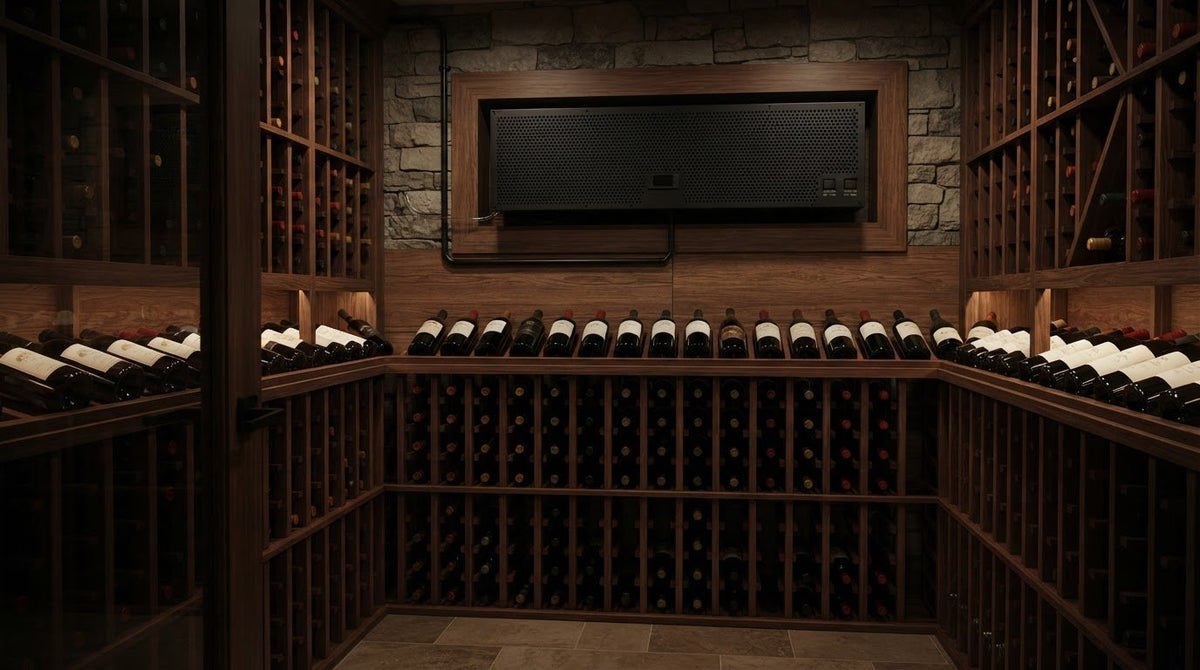
A cooling unit can fit neatly through a wall and still be the wrong choice for a cellar. Effective wine cellar climate control depends on selecting a unit suited to the room and its heat load. Through-the-wall wine cellar cooling units maintain storage temperatures between 45°F and 65°F (7°C and 18°C).
Look beyond a cooling unit’s size or appearance when planning wine cellar climate control. The cellar’s insulation, heat sources, humidity needs, and ventilation all affect performance. This guide explains how these factors inform system selection and installation.
You’ll also learn how temperature and humidity affect wine storage, what influences energy use, and why the unit needs an appropriate place to release heat. This context clarifies the decisions behind a stable cellar environment and the value of thoughtful design.
Key Takeaways
- Understand when ducted cooling can suit a cellar and how its layout affects the system choice.
- Learn how temperature stability and humidity, including a 50-65% RH target, support wine storage.
- See the practical advantages of through-the-wall systems and the considerations that shape their installation.
- Discover why wine cabinets are roughly 60% more energy efficient than traditional wine cellars.
- Know which room conditions and heat sources professionals weigh when assessing a cellar’s cooling needs.
Wine Cellar Cooling Units: Which Will Work Best for You?
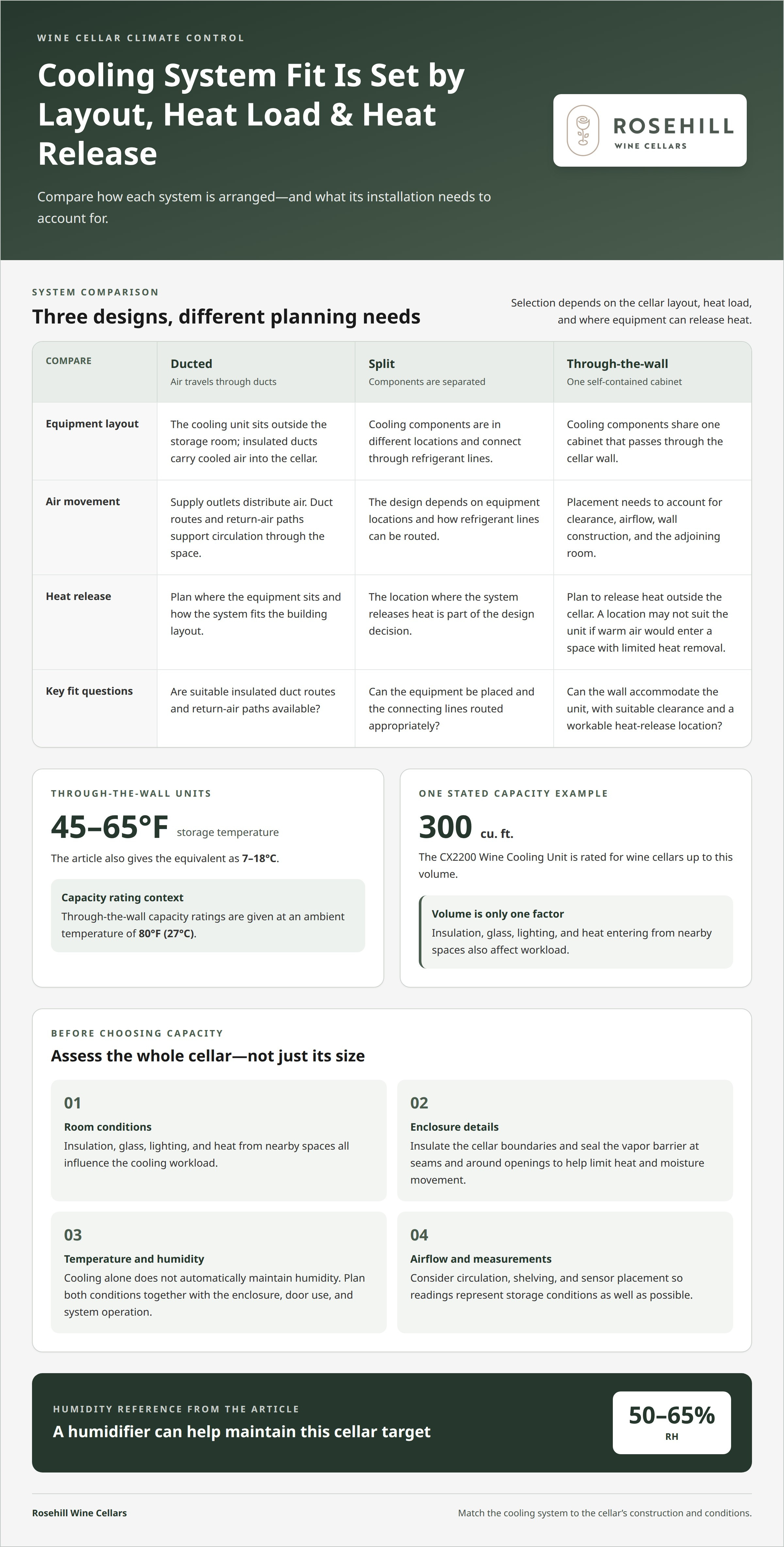
The right cooling system depends on the cellar layout, heat load, and equipment location. Professionals compare ducted, through-the-wall, and split designs before selecting capacity.
Ducted Cooling Systems
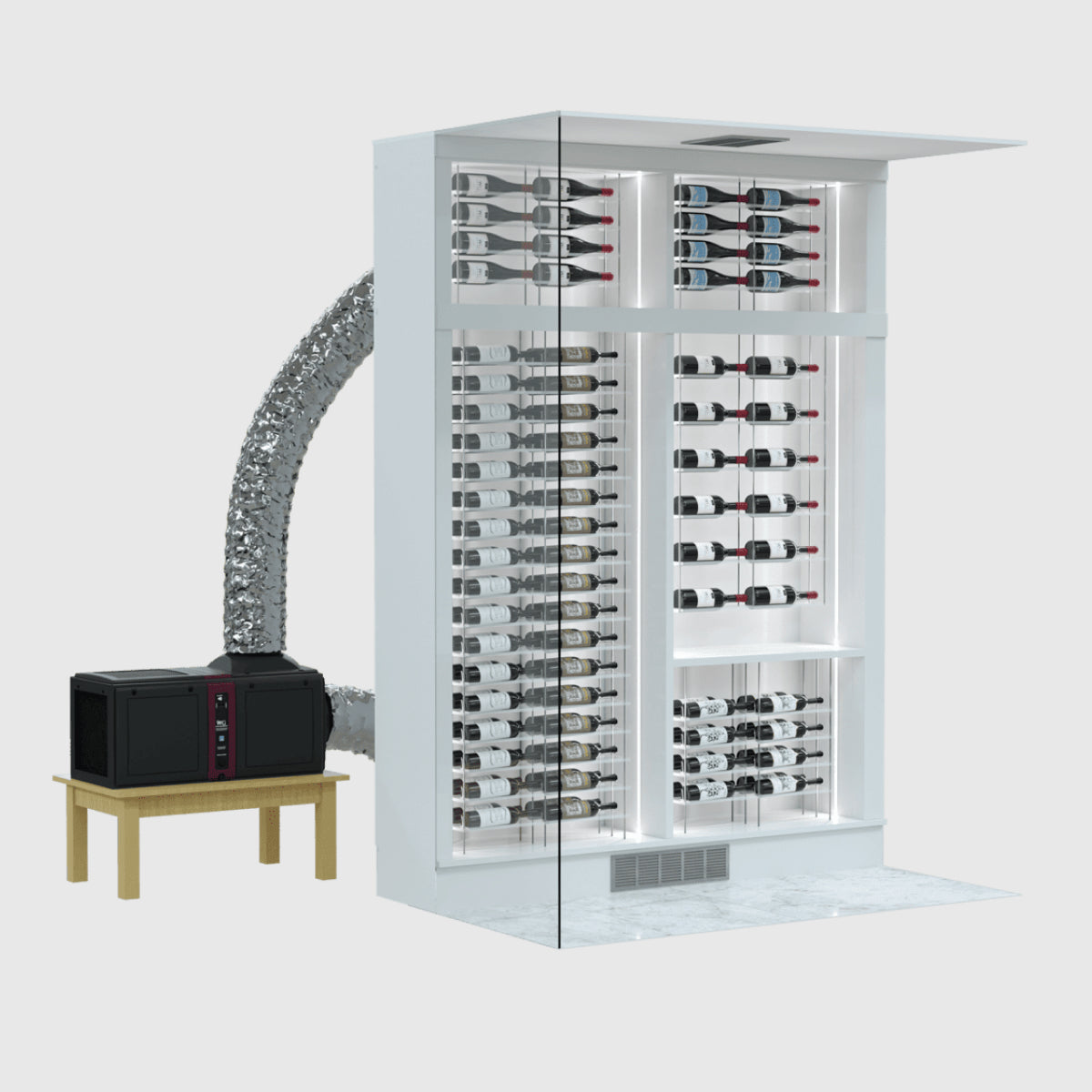
Ducted systems move cooled air from a cooling unit through insulated ducts into the cellar. This keeps the main equipment outside the storage room, while supply outlets distribute air. The design needs suitable duct routes and return-air paths to support circulation throughout the space.
A split system separates cooling components into different locations, connecting them through refrigerant lines. Its design depends on where the equipment can go, how the lines can be routed, and where the system will release heat. These factors determine whether a split configuration suits the building and cellar.
Through-the-Wall Cooling Units
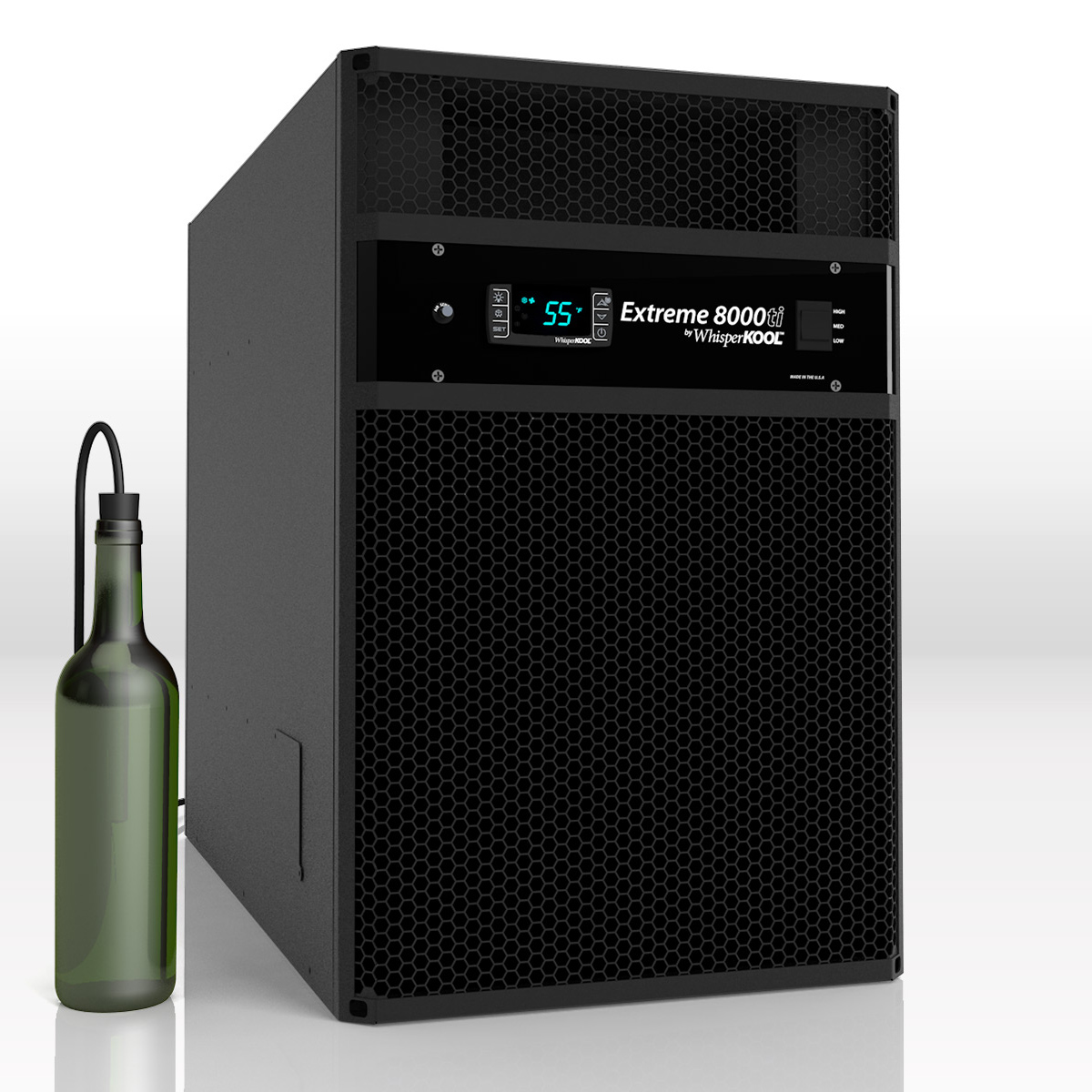
A self-contained through-the-wall unit places its cooling components in one cabinet that passes through the cellar wall. These units maintain storage temperatures between 45°F and 65°F (7°C and 18°C). The installation requires a suitable wall location and a plan for releasing heat outside the cellar.
A through-the-wall unit has a straightforward layout, but placement is crucial. Account for wall construction, clearance, airflow, and conditions in the adjoining room. It may not suit a wall that cannot accommodate the unit or a location where warm air would discharge into a space with limited heat removal.
Capacity and Ambient Temperature Ratings
Cooling capacity indicates how much heat a unit can remove under stated conditions. Through-the-wall units have capacity ratings at an ambient temperature of 80°F (27°C), so professionals compare the rating with the cellar’s heat load and installation environment. A CX2200 Wine Cooling Unit is rated for wine cellars up to 300 cu. ft.
Room volume is only one part of system selection. Insulation, glass, lighting, and heat entering from nearby spaces also affect the unit’s workload. Assess these conditions together instead of choosing a cooling unit based on cellar size alone.
The enclosure should also limit heat and moisture movement. Insulation covers the cellar’s boundaries, and a vapor barrier, which helps prevent moisture from passing into insulated walls or ceilings, should be sealed at seams and around openings. This helps protect the insulated assembly from moisture entering through gaps.
Cooling Systems and Standard Air Conditioners
Wine cellar cooling systems are designed to maintain the storage conditions required by the cellar, while standard air conditioners serve general room comfort. Their controls and operating demands differ, so an ordinary air conditioner may not suit a dedicated wine room. For broader residential climate control and airflow management throughout the rest of the house, teams like Happy Home HVAC Solutions specialize in standard home cooling. Professionals match the system to the intended storage environment and the cellar’s construction.
How much does wine cellar cooling equipment and installation cost? Cost depends on the project and is provided after a quote request. System type, capacity, installation complexity, and cellar construction all affect the estimate. Through-the-wall, ducted, and split systems each involve different planning and installation needs.
Wine cellar temperature and humidity regulation
Wine cellar climate control manages two connected conditions: temperature stability and moisture in the air. Cooling equipment can affect both, but cooling alone does not automatically maintain humidity. Plan temperature and humidity together, taking account of the enclosure, door use, and system operation.
Temperature consistency matters because repeated swings can disturb the conditions surrounding stored bottles. For example, a cellar beside a warm room may face changing heat loads as that adjoining space warms and cools. Professionals consider how the cellar is used, where heat enters, and how air moves before deciding on controls. The aim is a stable environment, not simply a low reading on a thermostat.
Humidity supports the cork and the cellar itself. A humidifier can be added to maintain a wine cellar humidity level of 50-65% RH. This gives the design a clear reference point, while the enclosure and cooling system still affect the result. If the air becomes too dry, corks may lose moisture; excess dampness can encourage mold and affect labels or nearby materials.
What are the risks of incorrect temperature or humidity for wine storage? Unstable or unsuitable conditions can compromise corks, labels, and the wine’s development over time. Excessive dryness can affect cork integrity, while persistent dampness may encourage mold growth.
Wine cellar humidifiers and accessories should complement the cooling system, not serve as an isolated fix. Consider the room’s construction, air movement, and how cooling affects moisture levels. A tightly sealed cellar, for instance, may behave differently from one with frequent door openings. Choose an arrangement suited to the space’s actual conditions.
Temperature and humidity management also depends on sensor placement and control settings. A reading near a doorway may differ from one among the bottles, so professionals consider where measurements best represent storage conditions. They also account for how the cellar is laid out, including shelving that can affect airflow around stored wine. These decisions make monitoring more useful.
During cellar design, plan insulation, vapor sealing, cooling, and humidification as connected elements. This helps limit unwanted heat and moisture movement through walls and ceilings, giving the cooling system a more predictable environment to manage. A cellar with substantial glass, for example, needs an enclosure suited to its temperature and humidity targets.
For an existing cellar, assess temperature patterns, humidity readings, door use, and equipment behavior before recommending adjustments. A humidifier may help address low humidity, while sensor placement or enclosure details may matter more in another room. The right response depends on the cause, so evaluate temperature and humidity together.
Benefits of through-the-wall systems
A through-the-wall system places the cooling unit in an opening between the cellar and an adjoining space. Its compact, self-contained design can simplify placement when the wall and heat-discharge location suit the room. The tradeoff is the need for a suitable wall, clear airflow, and somewhere for the removed heat to go.
Unlike a ducted system, a through-the-wall unit sends cooled air directly into the cellar rather than through ducts. This can avoid routing supply and return ducts through ceilings or walls. Ducted cooling can work when the main equipment needs to sit farther away; through-the-wall cooling may suit a cellar with a practical shared wall.
A split system separates the cellar’s indoor cooling component from the condenser, which releases heat. In a ductless split design, refrigerant lines connect the components, carrying the fluid that transfers heat between them. This layout can help when a through-wall opening is unsuitable, but line routing and condenser placement still need careful planning.
Ducted split systems add air ducts to a split arrangement. Plan the condenser location, equipment access, duct route, and air outlets as one connected design. For example, ducts can deliver air to a cellar beneath a finished room without placing a cooling unit inside the wine room. The route must still accommodate the building’s structure.
Water-cooled systems release heat through water rather than discharging it into the surrounding air. This can matter when warm-air exhaust has no suitable destination. Installation depends on the location of water connections and the system’s requirements. Compare those conditions with air-cooled options before selecting a design.
Through-the-wall systems are one option among several wine cellar cooling systems. Their value comes from a direct arrangement, not from being right for every cellar. A wall shared with a hot utility room, for instance, may complicate heat release; an open adjoining space may present a different installation plan.
When selecting a system, consider the cellar layout, adjoining rooms, heat discharge, equipment access, and air distribution. Assess whether a ducted, ductless, split, or water-cooled design fits the project. These decisions balance equipment placement with the room’s appearance and practical needs.
Choose through-the-wall cooling when the wall opening, clearance, and heat-discharge path work together. Consider a ducted or split design when the equipment location or room layout calls for another approach. The right system suits the cellar’s construction and can cool it without obstructed airflow or poorly placed equipment.
Energy efficiency
Wine cabinets are roughly 60% more energy efficient than traditional wine cellars. A cabinet cools a contained storage space, while a cellar’s energy needs also reflect its walls, door, lighting, and cooling equipment. The comparison helps frame the choice, but the right solution depends on how much wine the space must hold and how it will be used.
For a dedicated cellar, efficiency starts with limiting the heat and moisture entering the room. Treat insulation, door seals, glass, lighting, and adjacent spaces as parts of one design. A glass wall, for example, can change cooling demand compared with an enclosed wall. Controlling these conditions can reduce the work required from the cooling system.
Equipment selection matters too. A unit poorly matched to the cellar may run more than necessary or struggle to maintain stable storage conditions. Assess the room’s heat load and the unit’s capacity together, then plan where warm air will go. Efficiency depends on more than equipment size alone.
Split systems separate the cellar’s indoor cooling component from the condenser, which releases heat elsewhere. This can direct heat away from the wine room, but the system still needs appropriate installation and airflow. Ducted designs also require routes and connections that deliver air effectively, rather than allowing cooled air to escape into unused spaces.
Temperature and humidity settings also influence energy use. Set conditions for wine storage rather than making repeated adjustments for short-term comfort. Consider how controls respond to the room and position sensors to reflect cellar conditions. A sensor beside a warm doorway, for example, may not represent the environment around bottles farther inside.
During installation, assess the enclosure, cooling equipment, control placement, and heat discharge as a connected system. This can identify unnecessary demand, such as gaps around a door or an obstructed air path. Also consider lighting and equipment access, since blocked airflow or frequent disruption may affect operation.
Ongoing performance depends on maintaining the designed airflow and equipment condition. Maintenance planning can include inspections of accessible components and control operation. Changes in cellar use, such as adding a glass display or increasing bottle storage, may alter cooling demand. Review the system against the room’s new conditions to support efficient operation.
Heat-load calculation for wine cellars
A heat-load calculation estimates how much warmth enters a cellar and how much the room produces. Use this assessment to select cooling equipment suited to the space. Cellar dimensions matter, along with surrounding rooms, construction materials, glass, lighting, and equipment. A compact cellar with a glass wall may need a different system from an enclosed room of similar size.
Start by assessing the cellar’s boundaries. Review walls, ceilings, floors, doors, and windows to understand where heat can pass through, as well as the spaces beyond those surfaces. A wall beside a warm utility room, for example, presents different conditions from one adjoining a cooler interior room. Insulation and sealed gaps also affect how much heat reaches the cellar.
Next, account for heat sources inside or near the wine room. Lighting adds heat while operating, frequently opened doors can bring in warmer air, and glass surfaces may affect heat gain. Consider how these features will be used rather than assuming the cellar will remain closed and unoccupied.
Equipment location is another part of the calculation. A cooling unit removes heat from the cellar and releases it elsewhere, so the heat-discharge area and available airflow influence installation. With a split system, the indoor component and condenser occupy separate locations. Ducted wine cooling also requires planning for duct routes and air delivery.
Professionals bring these details together to estimate the cooling demand. They consider the cellar’s volume alongside heat entering through its enclosure and heat produced by its contents and use. Bottle storage affects layout and airflow, while racking and display choices can influence how air circulates. The goal is to select equipment for the room’s real conditions, not its dimensions alone.
- Room form: dimensions, ceiling height, doors, and glass surfaces.
- Construction: insulation, vapor sealing, and adjoining room conditions.
- Operation: lighting, door use, equipment placement, and planned storage.
- System design: capacity, air distribution, and heat-discharge location.
These factors explain why cellars with comparable floor areas may need different cooling capacities. An enclosed room with effective insulation has a different heat profile from one with extensive glazing and warm adjacent spaces. A ducted system also has different installation needs from a self-contained unit because its air path and equipment location shape the design.
After installation, changes to the room can affect the original assessment. Adding glass, changing lighting, or increasing stored inventory may alter heat gain or airflow. A professional can reassess those conditions and determine whether the existing wine cooling arrangement remains appropriate. This keeps equipment selection connected to the cellar as it is actually built and used.
Rosehill Wine Cellars: Custom Wine Cellar Design
Rosehill Wine Cellars brings cellar design, storage, and climate needs into one considered plan. Turn to its Custom Wine Cellar Design when you’re planning a new cellar or shaping an existing space. The design can account for the room’s layout and wine storage goals, helping align the cellar’s form with its practical requirements.
For a tailored storage arrangement, Premier Cru Classic Racking and Premier Cru Modern Racking offer distinct racking styles. The Vantaggio V300 Wine Cabinet provides another storage option for a project suited to a cabinet rather than a custom cellar. These choices help connect the overall design with the way you intend to store and display your collection.
Contact Rosehill Wine Cellars to discuss your custom cellar design.
Plan a Cellar That Grows With Your Collection
Your next decision can shape how your collection fits into your home over time. Consider how you want to find, store, and display bottles as your needs change. That vision gives the design process a useful starting point, connecting wine cellar climate control with the room’s purpose and the details you value.
Rosehill Wine Cellars can bring those preferences into a custom cellar plan. Choose between Premier Cru Classic Racking and Premier Cru Modern Racking to define the storage style, or consider the Vantaggio V300 Wine Cabinet for a cabinet-based approach. Each option can help inform how the space is arranged around your collection.
A thoughtful plan brings technical requirements together with personal character. Share your goals for the space and explore a design direction that feels right for your home.
Contact Rosehill Wine Cellars to take the next step toward your wine cellar.
Frequently Asked Questions
What is a Through-the-Wall Cooling Unit?
A through-the-wall cooling unit is a self-contained appliance installed in an opening between a wine cellar and an adjoining space. Its cabinet houses the cooling components, making it a possible fit where ductwork would be difficult. Before selecting one, assess the wall, nearby power access, and where warm air will discharge. For an existing cellar, these details help determine whether the location is practical.
What temperature and humidity should a wine cellar maintain?
A recommended target for wine storage is 12°C-15°C (55°F-59°F), with humidity at 60%-70%. The room’s construction and cooling arrangement influence how consistently it can hold those conditions. A professional can consider the cellar’s use and the equipment controls when setting an approach. For a collection containing different wine styles, the design should reflect the storage goal for the collection, rather than assume every bottle needs separate climate settings.
How do professionals size a wine cellar cooling system?
Size a system by assessing the cellar’s dimensions, insulation, glass, lighting, adjacent spaces, and intended use together. Also account for equipment placement and the unit’s published capacity rating. For a new cellar, plans can show whether a display wall or changing storage layout affects cooling demand. This helps match equipment to the finished room rather than relying on floor area or bottle count alone.
What are the different types of wine cellar climate control systems?
Common options include self-contained through-the-wall units, ducted systems, split systems, and water-cooled systems. A wine cabinet is another option for contained bottle storage rather than a dedicated cellar. The best configuration depends on available space, equipment placement, and how cooled air and extracted heat can be managed. Compare these choices with the building layout and intended storage arrangement.
How do professionals install and maintain a wine cellar climate control system?
Plan equipment placement, air delivery, heat discharge, and control locations before installation. Then assess system operation and whether controls reflect conditions in the storage area. Maintenance can include scheduled inspections and preventative care for cooling units and cellar systems. Rosehill Wine Cellars offers maintenance plans for these systems. A change to the room’s layout or use can also prompt an assessment of equipment performance.
What electrical, ventilation, and building code requirements apply to wine cellar cooling systems?
Applicable requirements depend on the equipment, installation, and local jurisdiction, so there is no single specification for every cellar. During planning, review the selected unit’s electrical information, required clearances, airflow, and heat-discharge arrangement. Building conditions can affect the installation approach. Electrical and building work should follow the codes that apply to the project, alongside the system manufacturer’s instructions.
Which wine cellar cooling brands and models are best reviewed?
Review rankings can change, and a high rating alone does not establish that a unit suits a particular cellar. Compare recent owner feedback for patterns in operating performance, noise, installation experience, and support, then match those observations to the unit’s published capacity and design. Rosehill Wine Cellars offers wine cooling units, but the right model depends on the room and installation conditions, not a universal “best” list.