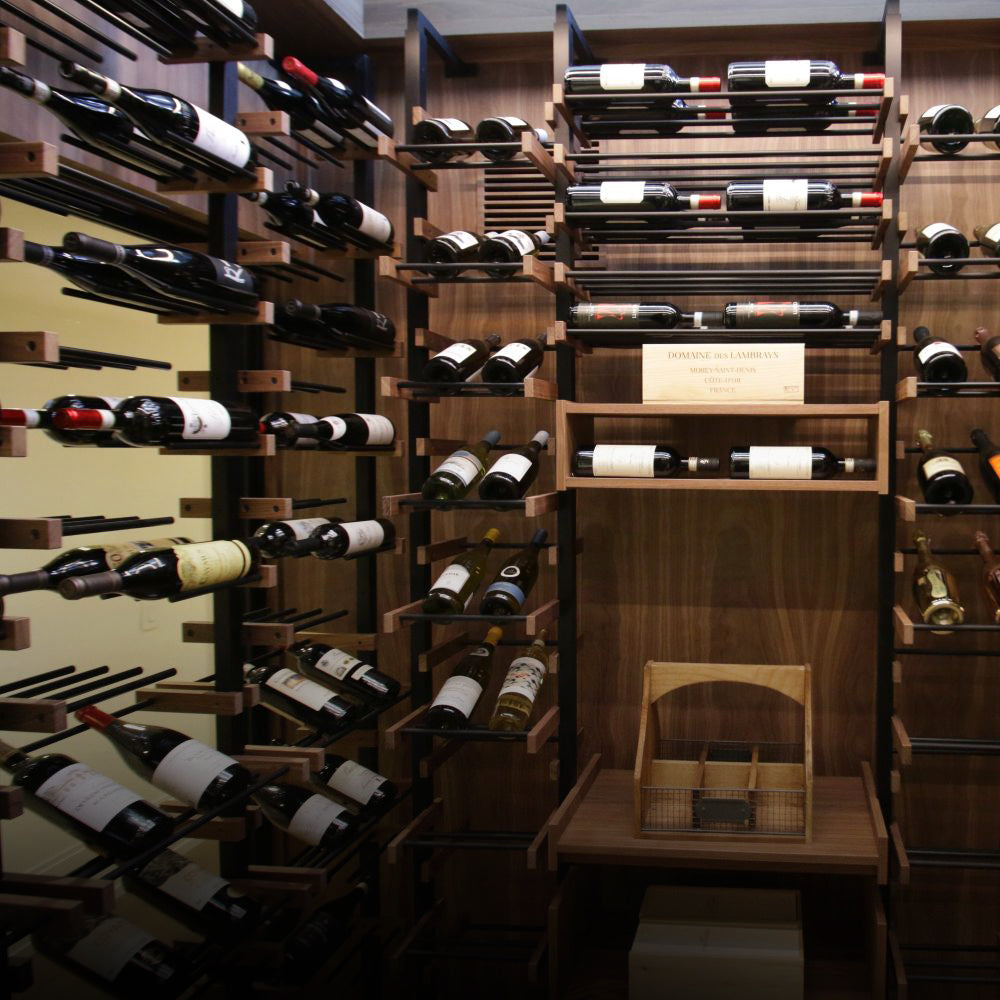








A standard wine-rack slot can be too narrow for a Champagne bottle. For champagne bottle diameter and racking slot dimensions, a 3.5-inch clear opening is a useful fit for a typical 750 mL bottle, which is approximately 3.3-3.6 inches in diameter. Wider Champagne bottles and magnums may need a larger slot, with magnum openings generally starting at 4 inches.
If you’ve found that a bottle’s volume doesn’t tell you whether it will fit, you’re right: its shape matters just as much. This guide explains typical champagne bottle diameter and racking slot dimensions, the clearance a rack needs, and why sparkling-wine bottles and larger formats can change the fit.
Learn how to compare a bottle’s widest point with a rack’s usable opening, what to consider for magnums, and how wider slots affect capacity. The goal is a rack that accommodates your bottles comfortably while keeping the cellar layout practical.
Key Takeaways
- Measure each bottle at its widest point, then compare it with the rack’s clear opening and the space needed to slide it in and out.
- Champagne bottles vary in diameter, so a slot that fits one bottle may not comfortably suit every sparkling-wine shape.
- Magnums need more than a wider opening: consider their length and the rack’s depth to ensure they sit securely.
- Wider bottle bays can reduce a rack’s practical capacity, even when its advertised count is based on standard bottles.
- For a collection with mixed formats, plan the rack layout around the bottles you actually store, rather than assuming every slot will fit every shape.
Do wine racks fit magnums?
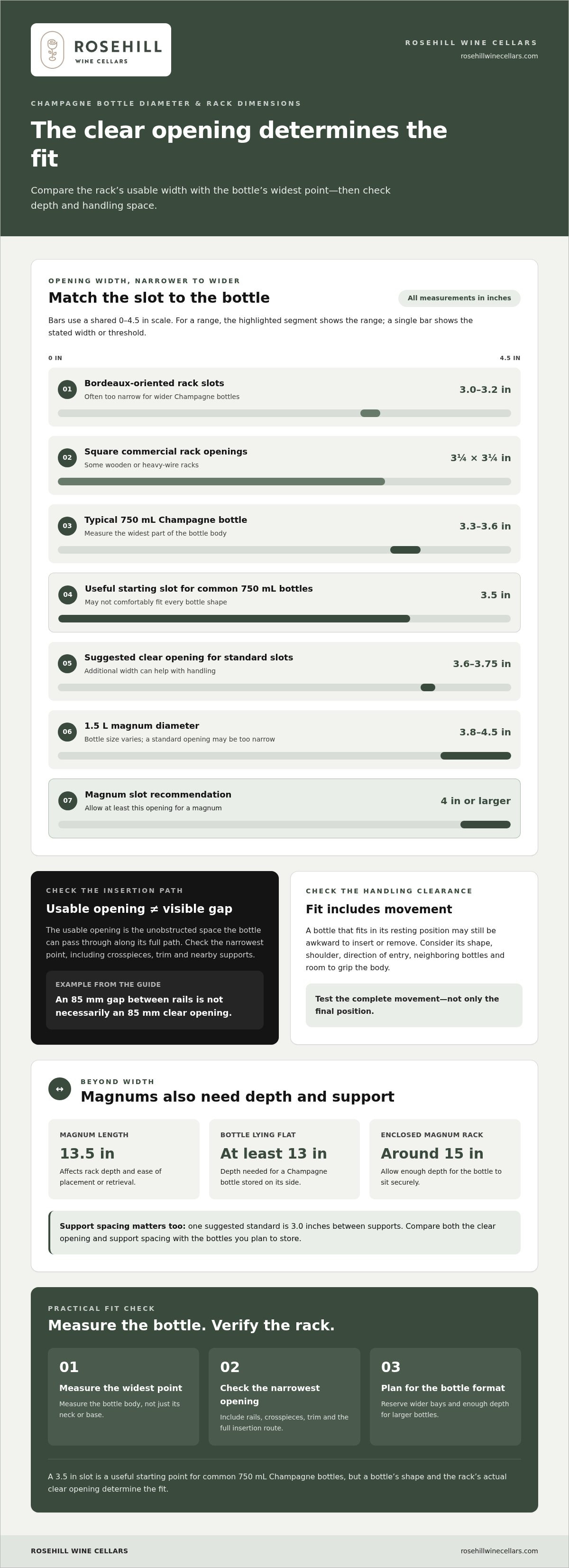
Some wine racks fit magnums, but a standard bottle opening may be too narrow. A 1.5 L magnum is approximately 3.8-4.5 inches in diameter, while a magnum slot should be 4 inches or larger. Its 13.5-inch length also affects rack depth and how easily you can place or retrieve it.
Bottle orientation changes the space a rack must provide. For long-term storage, Champagne should lie on its side, so the rack needs enough depth and support for the bottle’s length. An enclosed rack needs around 15 inches of depth for a magnum; a Champagne bottle lying flat needs at least 13 inches.
Double-depth storage can increase capacity, but it also makes access less direct. A bottle in the back row may be difficult to reach when a front-row bottle blocks its path. Reserve deeper positions for bottles you retrieve less often, and keep frequently opened Champagne or magnums closer to the front. Leave a clear route for removing each bottle without shifting its neighbors.
Safety matters when a rack carries heavy glass bottles. A full Champagne bottle can weigh up to 3.5 lb, so distribute bottles evenly and avoid loading one side heavily while the other remains empty. Install the rack level and secure it appropriately for its location and construction. Keep bottles supported during placement, and don’t pull one from a tight opening in a way that could disturb adjacent bottles.
Mixed collections benefit from distinct storage zones. Standard Bordeaux bottles, around 3.0 inches in diameter, can use narrower openings than magnums or oversized Champagne. Reserve wider bays for those larger shapes instead of sacrificing space across every row. For example, a 3 L double magnum holds the equivalent of four standard 750 mL bottles, yet its wider body may require a dedicated position.
Volume alone doesn’t predict fit: two bottles with the same capacity can have different diameters and lengths. That difference affects slot width, rack depth, and the clearance needed for removal. A layout that separates standard bottles from larger formats makes those trade-offs easier to manage. Modern wine racking can inform planning for a cellar with varied bottle shapes, including dedicated space for wider formats.
What size wine rack slot fits a Champagne bottle?
A 3.5-inch slot is a useful starting point for common 750 mL Champagne bottles. The fit depends on the bottle’s widest point and the rack’s actual usable opening.
Champagne Bottle Diameter and Slot Width
Slot width is the clear horizontal space available for a bottle’s widest section. A typical 750 mL Champagne bottle measures approximately 3.3-3.6 inches across, so a 3.5-inch opening may not accommodate every bottle comfortably.
Measure the bottle body, not just its neck or base. A 3.5-inch slot takes common 750 mL bottle shapes, though standard bottles may sit slightly loose. A wider Champagne shape can press against the rack members or refuse to enter. Bordeaux bottles are often narrower, so a rack sized around Bordeaux may not suit every sparkling-wine bottle.
Choose a slot based on the largest bottle assigned to it. This avoids forcing a bottle through a tight opening or leaving it poorly supported in an oversized bay.
Usable Openings and Insertion Paths
A usable opening is the unobstructed space a bottle can pass through along its entire insertion path. It may be smaller than the apparent gap between rack rails or supports.
Check the opening at the narrowest point, including crosspieces, trim, and neighboring structure. An 85 mm gap between vertical rails, for example, isn’t necessarily an 85 mm clear opening. The bottle must travel into its resting position without catching at the entrance or striking a support.
For a custom wine rack, compare the bottle’s widest diameter with the specified clear opening. Consider the direction of entry, too: a bottle angled through a restricted path needs more maneuvering room than one placed straight into an open bay.
Clearance for Bottle Handling
Handling clearance is the space around a bottle that lets you insert and remove it without rubbing against adjacent supports. It matters because a close numerical match can still make everyday access awkward.
A 3.6-3.75-inch clear opening is a commonly suggested standard slot range, but the bottle’s shape affects how it moves through that space. Leave enough room to grip the bottle body and draw it out smoothly. A broad shoulder or rounded body may contact the rack before its widest point clears.
Test the complete movement, not just the bottle’s final position. Account for neighboring bottles and projecting rack members, especially where a tight row limits hand access.
Rack Opening and Support Dimensions
Rack dimensions include both the clear opening and the spacing between bottle supports. Both matter: the opening must admit the bottle, while the supports hold it securely.
Many standard Bordeaux-oriented slots measure 3.0-3.2 inches wide. Some commercial wooden or heavy-wire racks use square openings of 3¼ by 3¼ inches, which may be too narrow for a wider Champagne bottle. A 3.5-inch slot is more accommodating for common 750 mL shapes, while a suggested 3.6-3.75-inch clear opening offers additional width.
Vertical spacing also affects the resting position: one suggested standard is 3.0 inches between supports. Compare both dimensions against your bottles before settling on a layout. For varied bottle shapes, modern wine-racking layouts can help inform how wider openings fit into a cellar plan.
Champagne and sparkling-wine bottle diameter
A 750 mL Champagne bottle is often wider than a standard Bordeaux bottle, affecting rack and refrigerator fit. Compare bottle shape and height as well as capacity when planning storage.
Comparing Champagne and Standard Bottles
Champagne and standard wine bottles differ in diameter, height, and body shape, even when both hold 750 mL. A typical 750 mL Champagne bottle measures approximately 3.3-3.6 inches in diameter, while standard wine bottles commonly measure about 3-3.2 inches.
That difference matters in a wine cellar: a Bordeaux bottle may fit a narrow opening that cannot accommodate a wider sparkling-wine bottle. Champagne needs room for its broader body, so a mixed collection can take up more rack space than its bottle count suggests.
Height varies, too. A typical 750 mL Champagne bottle is approximately 11.5-12.5 inches tall; standard 750 mL wine bottles span approximately 11.5-13 inches. Compare both dimensions before assigning bottles to a rack or refrigerator.
Bottle Fit in Racks and Refrigerators
Bottle fit depends on the clear width and depth of each rack or refrigerator position. A Champagne bottle measuring 3.6 inches across won’t pass through a narrower opening, even if the storage space behind it looks generous.
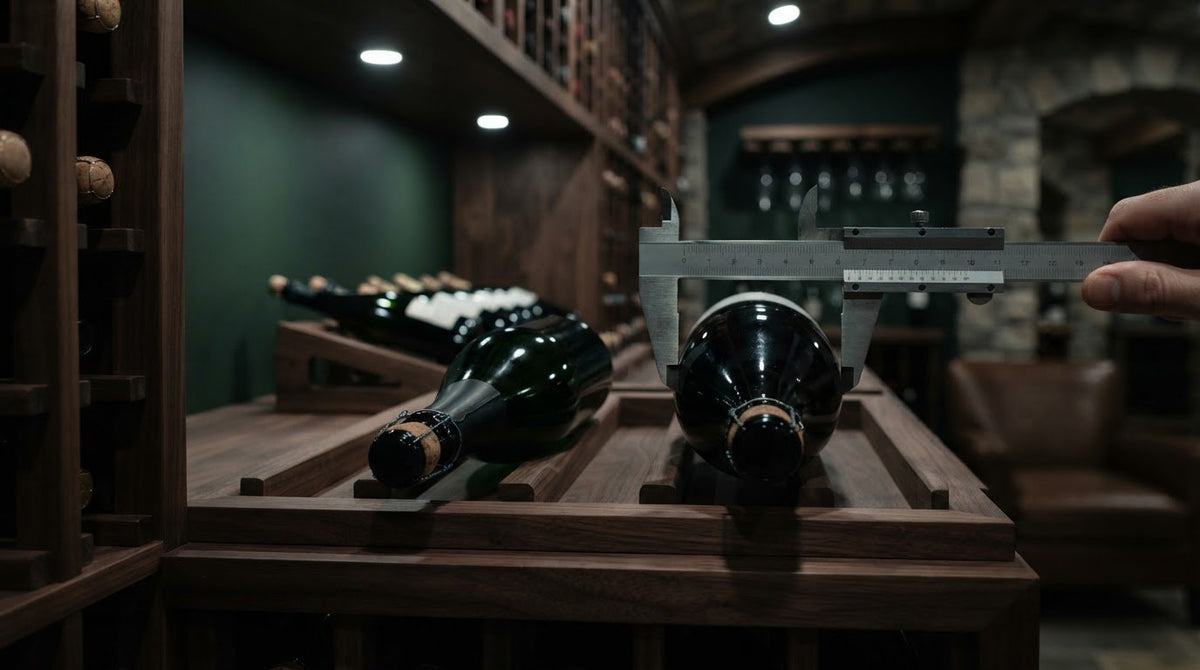
Measure the bottle at its widest point, then compare it with the usable opening. Check the entire path into the position, including rails, shelves, and neighboring bottles. In a refrigerator, a broad bottle body can prevent the door from closing properly or crowd an adjacent bottle, even when the overall volume seems sufficient.
For a cellar with Champagne, Cava, and Prosecco, group bottles by shape as well as wine style. All three may come in 750 mL bottles, but capacity alone doesn’t establish equal diameter or rack compatibility.
Maximum Dimensions Across Bottle Formats
There isn’t one maximum Champagne dimension that applies to every format. A 750 mL bottle is typically 11.5-12.5 inches tall, while a broader published range for 750 mL Champagne or sparkling wine is 12-13 inches. Bottle widths can vary, so check the dimensions of the specific bottle before choosing a rack.
Large-format capacity gives useful context, but not a precise diameter or height. A magnum holds 1.5 L and may measure 3.8-4.5 inches in diameter; larger formats include a 6 L Methuselah and a 9 L Salmanazar. Plan around the actual bottle shape, especially for formats beyond a standard bottle.
Material and load capacity should suit the rack’s design and the bottles it holds. A full Champagne bottle can weigh up to 3.5 lb, so use supports intended for bottle storage, follow the rack maker’s capacity guidance, and secure the structure appropriately. The weight of a complete collection depends on its bottle count and formats, not capacity labels alone.
Magnum bottle dimensions and rack compatibility
Magnums need wider openings and more length than standard bottles. Their dimensions can affect both rack fit and the usable capacity of a collection, especially when Champagne and Burgundy bottles share storage.
A 1.5 L magnum measures approximately 3.8-4.5 inches in diameter and 13.5 inches long. That range is broad: an opening of 4 inches may suit a narrower magnum, but won’t accommodate one measuring 4.5 inches across. Measure the bottle’s widest point, including its shoulder, then compare it with the clear rack opening and insertion path.
Length matters as much as width. An enclosed rack needs around 15 inches of depth for a magnum, allowing the bottle to rest without projecting into an aisle or pressing against a door. Check depth from the front edge to the back support, not just the cabinet’s exterior measurement. A bottle that fits the opening but cannot lie fully supported isn’t a practical fit.
Large formats need their own allowance. A double magnum holds 3 L, equivalent to four standard 750 mL bottles; a Champagne Jeroboam also holds 3 L. The shared volume doesn’t ensure a shared shape or rack fit. Measure the actual bottle, since body width and length determine whether it enters, rests, and comes out cleanly.
For 4 L-6 L bottles, rack recommendations list a 5-inch diameter. A Champagne Methuselah holds 6 L, making it a useful example when planning space for large formats. Don’t assign that bottle to a magnum opening by name alone. The wider body and greater volume call for a separate position with compatible opening and depth.
Plan wine racks in zones rather than sizing every bay for the largest bottle. Standard Bordeaux bottles measure about 3 inches in diameter, while Burgundy bottles can reach 3.5 inches. Keep those narrower shapes in standard positions, then reserve wider bays for magnums and large Champagne bottles. This approach preserves storage capacity without making oversized bottles difficult to retrieve.
Finally, account for access and future changes in the collection. A rack advertised for 100 bottles may hold fewer when wide formats take larger bays. Measure several examples from each bottle style, then map their widths and lengths to the intended positions. A dedicated 36-bottle magnum rack has also been used for Champagne and oversized bottles, illustrating how a separate zone can simplify mixed-format storage.
Champagne bottle diameter
Champagne bottles vary more in diameter than a single “standard” measurement suggests. A typical 750 mL bottle is approximately 3.3-3.6 inches across, but measured examples show why one slot width may not suit every bottle. For reliable planning, measure the actual bottle at its widest point, then match that dimension to the rack’s clear opening. Treat champagne bottle diameter racking slot dimensions as a paired check: bottle width informs the opening required.
Measurements from cellar-owner samples illustrate the variation within Champagne itself. Krug bottles measured 3.91 inches in diameter, while Comtes bottles reached 3.96 inches. A Dom Ruinart Blanc de Blancs bottle measured 3.99 inches, the largest Champagne bottle in that sample. These examples are wider than the typical 750 mL range, so bottle name and volume alone cannot establish a precise fit. For champagne bottle diameter racking slot dimensions, use the individual bottle measurement rather than relying on a producer or style label.
Smaller formats also differ. A Champagne half-bottle holds 375 mL, and measured examples included a Deutz Cuvée William at 2.9 inches and Krug half-bottles at 3.17 inches in diameter. That spread shows why “half-bottle” doesn’t mean a uniform shape. If a collection includes different producers, measure a representative bottle from each before assigning permanent rack positions.
Height and base details affect fit beyond diameter. A typical 750 mL Champagne bottle is approximately 11.5-12.5 inches tall, and its punt depth is 0.75-1.25 inches. Measure overall length, including the closure, when checking a shelf or enclosed rack. A bottle can clear the slot but still press against the back panel or extend beyond the support if depth is inadequate.
Format names describe volume, not guaranteed external dimensions. A magnum holds 1.5 L, a Rehoboam holds 4.5 L, a Methuselah holds 6 L, and a Salmanazar holds 9 L. Their diameters and lengths aren’t established by capacity alone. For larger formats, record each bottle’s widest point and overall length instead of scaling up a 750 mL measurement.
Use those measurements to map each bottle to its intended position: diameter determines the opening, while length and orientation determine depth and access. This is especially useful when sparkling wine shares storage with standard wine bottles, because the broader Champagne body may change how many bottles fit in a row. Explore modern wine racking to plan a layout around the formats in your collection.
Rosehill Wine Cellars: Vantaggio V300 Wine Cabinet
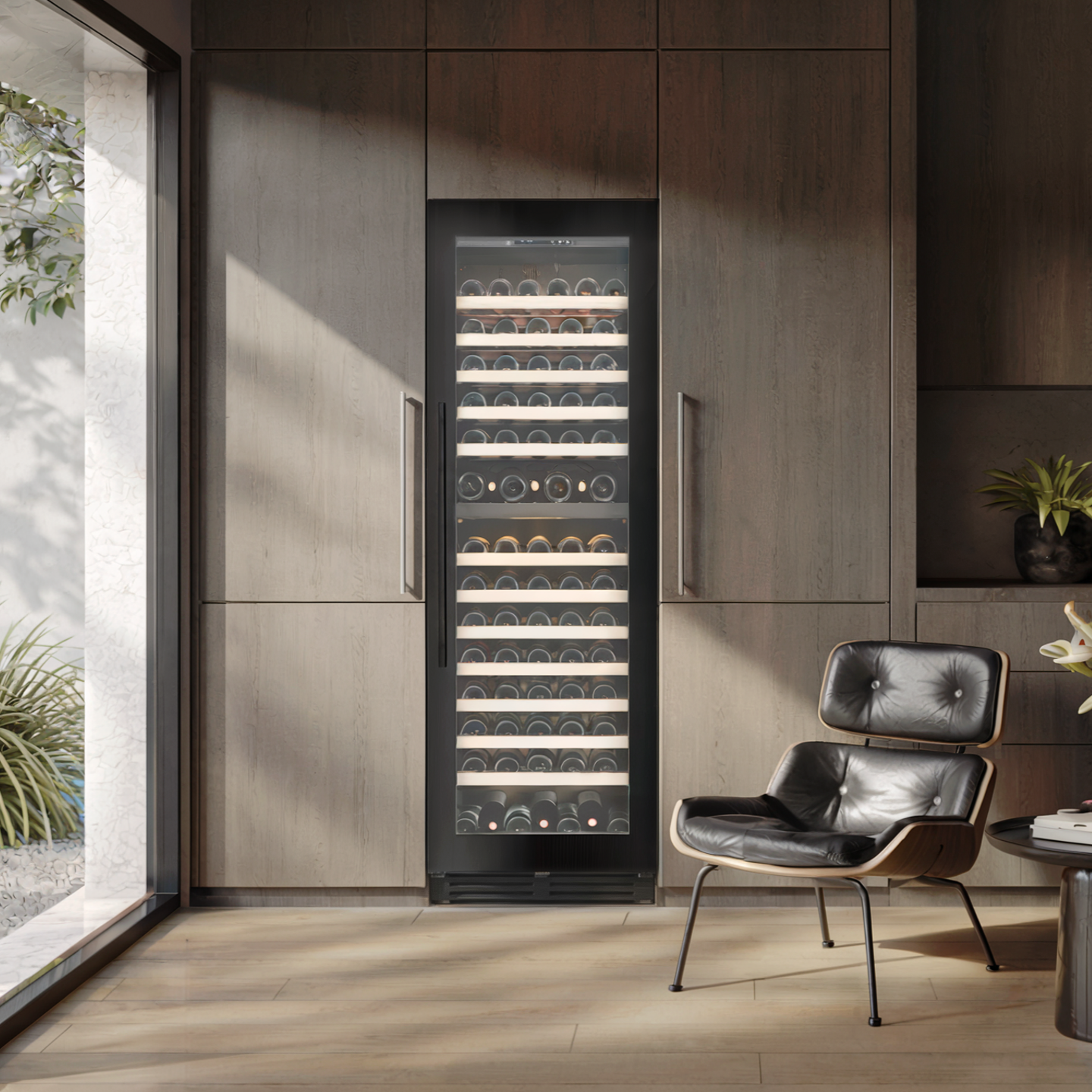
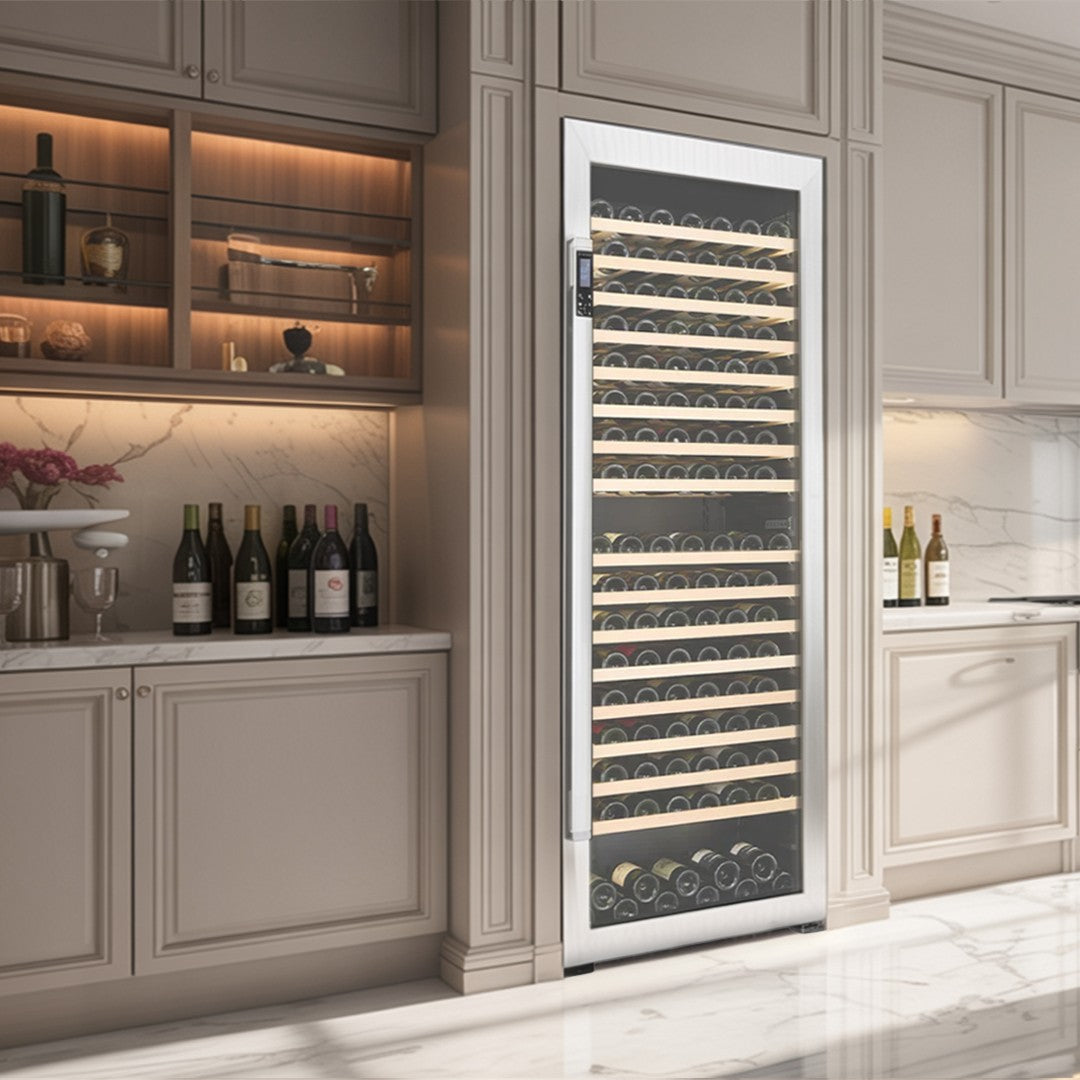
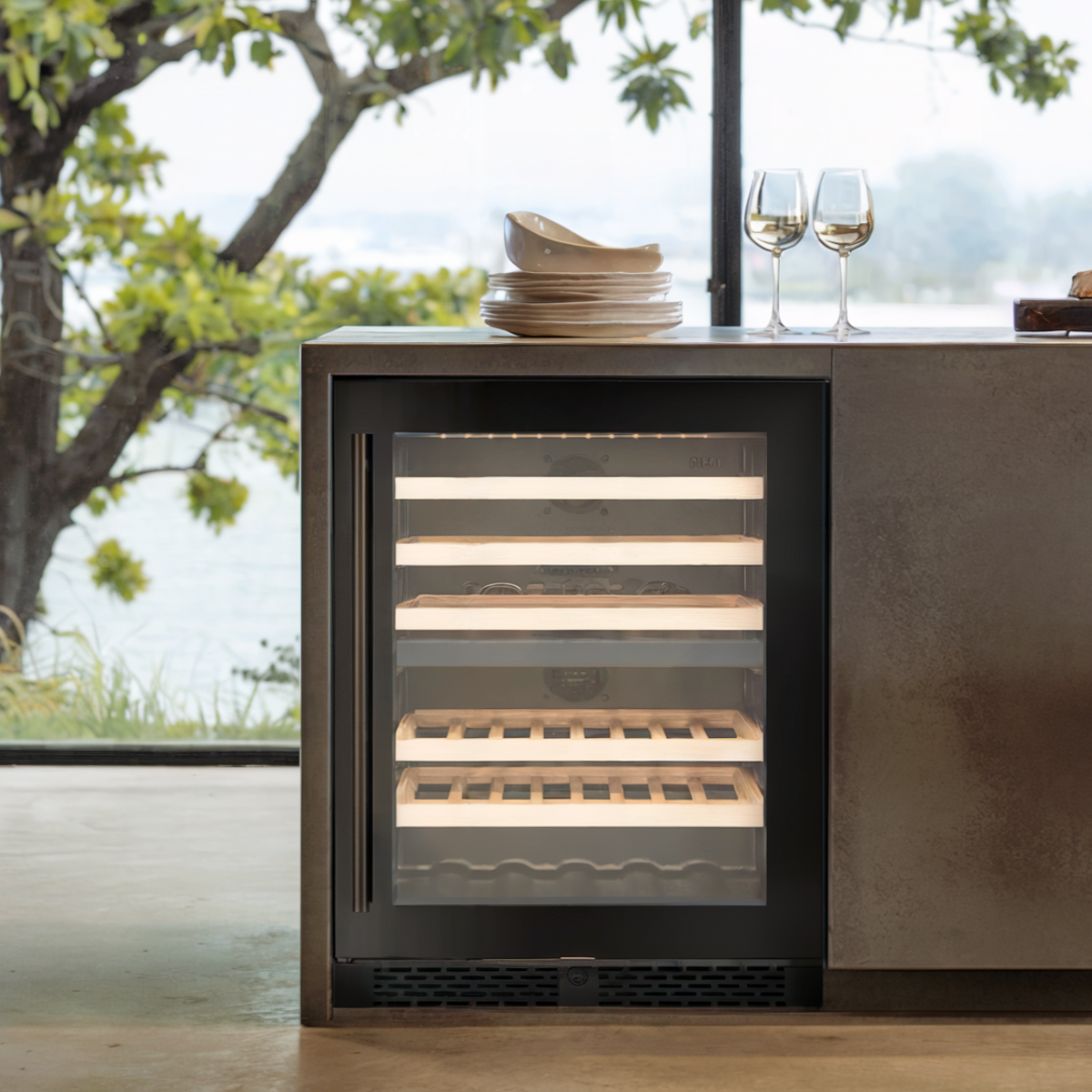
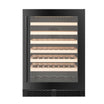
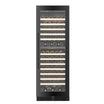
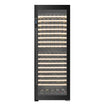
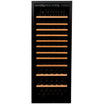
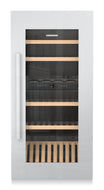
Rosehill Wine Cellars offers the Vantaggio V300 Wine Cabinet for readers seeking a dedicated wine-storage option. If your collection includes Champagne bottles with varied diameters, match the storage format to your collection: consider Premier Cru Classic Racking or Premier Cru Modern Racking for a racking layout, or explore the Vantaggio V300 Wine Cabinet as a cabinet option.
For a larger cellar plan, Rosehill Wine Cellars’ Custom Wine Cellar Design can bring bottle formats and storage requirements together in a considered layout. Wine Cooling Units can also be part of the plan when the cellar needs cooling. These serve different storage needs, so choose according to whether you’re planning a cabinet, racking, or a complete cellar.
Contact Rosehill Wine Cellars or visit rosehillwinecellars.com to discuss your wine-storage plans.
Plan a Cellar That Fits Your Collection
Plan storage around the bottles you intend to keep, not an assumed standard format. Treat champagne bottle diameter and racking slot dimensions as one design decision, alongside how you want to organize and access your collection. A simple inventory of bottle styles can help you decide whether a cabinet, dedicated racking, or a broader cellar plan best suits your space.
Rosehill Wine Cellars offers the Vantaggio V300 Wine Cabinet, Premier Cru Classic Racking, and Premier Cru Modern Racking. Each provides a different direction for planning wine storage, from a cabinet solution to a racking layout. Choose the approach that aligns with your collection and the room you have in mind.
For guidance on the next step, contact Rosehill Wine Cellars to discuss your wine-storage plans. A considered layout can bring bottle access and the character of your space together beautifully.
Frequently Asked Questions
What is the standard diameter of a 750 ml Champagne bottle?
A typical 750 mL Champagne bottle is approximately 3.3-3.6 inches in diameter. Individual bottles can vary beyond that range: measured examples include Champagne bottles close to 4 inches across. Capacity alone doesn’t establish the outside dimensions. For a bottle already in your collection, measure across its broadest body section, then compare that measurement with the rack’s usable opening.
What slot width and depth are recommended for Champagne bottle racking?
A 3.5-inch slot is a useful fit for common Champagne bottles, while an enclosed rack needs at least 13 inches of depth for a Champagne bottle lying flat. Check that depth along the bottle’s full resting path, including its closure. A wide bottle may need a larger opening, so use the actual bottle’s width rather than relying only on the 750 mL label.
How much clearance should be allowed between bottles and racking slots?
There’s no single clearance allowance that suits every bottle and rack. The key is enough usable space to insert and remove a bottle without its widest section catching on a support or neighboring bottle. Measure the bottle and opening at their tightest points, then consider the direction of entry and room for your hand. The nominal gap between rails may not equal the clear opening.
What are typical dimensions for Champagne bottle storage racks in the United States?
There’s no single rack dimension used for every Champagne bottle in the United States. Common commercial wooden or heavy-wire racks may have square openings measuring 3¼ by 3¼ inches, while suggested Champagne-friendly openings include 3.5 inches or wider. For an enclosed rack, allow at least 13 inches of depth for a Champagne bottle stored horizontally. Rack design and bottle shape both affect usable space.
Do Champagne bottle punt and base shapes affect racking slot dimensions?
Yes. A Champagne bottle’s punt, the indentation in its base, can measure 0.75-1.25 inches deep, and the base profile affects how the bottle rests on supports. Slot width still depends chiefly on the body’s widest point, but base contact influences stability and orientation. Check that the rack supports the bottle securely without relying on the punt alone to keep it in place.