





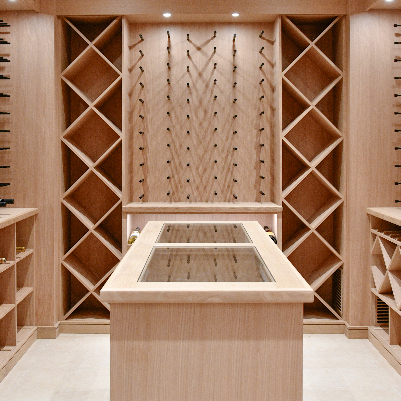









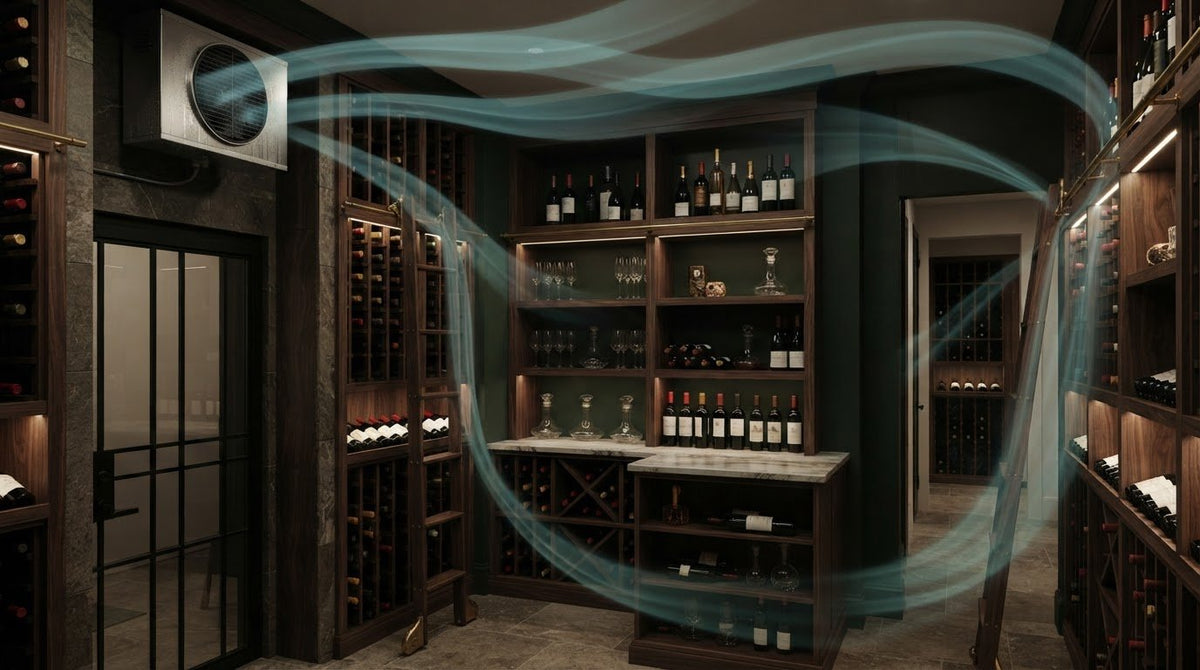
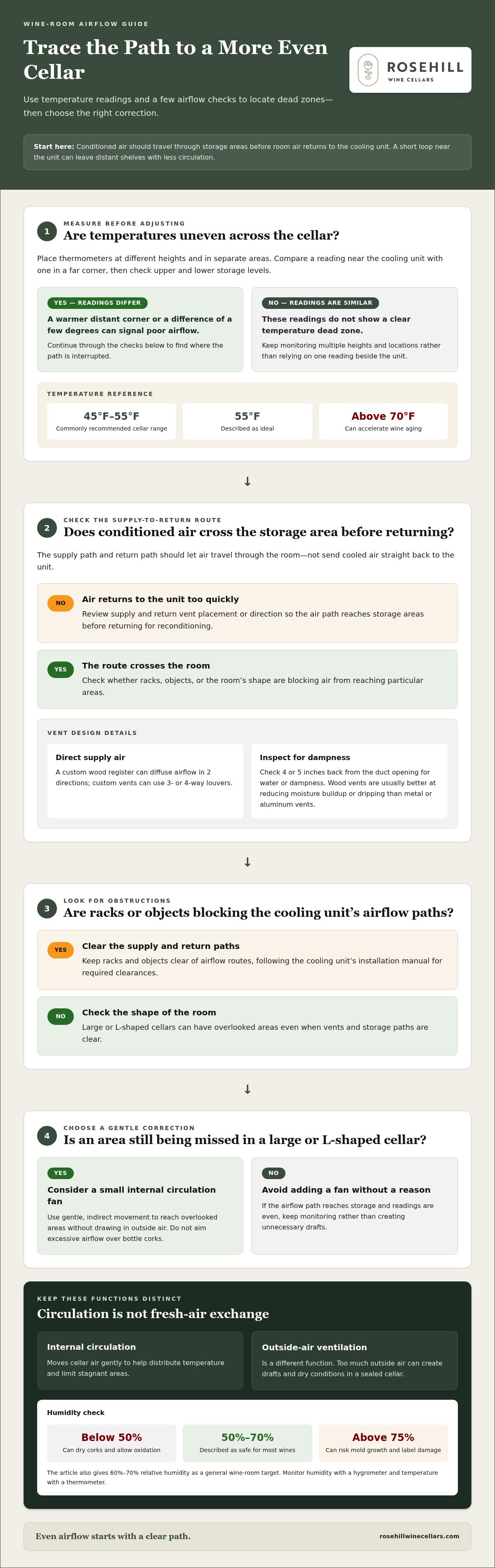
Hot spots usually mean conditioned air isn’t reaching every part of the cellar. Wine-room air circulation that eliminates hot spots depends on a clear path for air to move through the room, with supply and return vents positioned to prevent short-circuiting. In a large or L-shaped cellar, a small fan can gently circulate air into overlooked areas without drawing in outside air.
Even temperatures matter, but adding ventilation isn’t always the answer. In a sealed cellar, air circulation and fresh-air exchange are different things. Too much outside air can create drafts and dry conditions. Temperature readings at different heights and in distant corners can show where airflow is falling short.
This article explains how air moves through a wine room, why vent placement and cooling-unit clearances affect distribution, and how to spot dead zones. You’ll also learn how circulation in a sealed cellar differs from ventilation, and which design considerations can help create more even conditions for your collection.
Key Takeaways
- Compare temperature readings at different heights and in far corners to spot areas where conditioned air may not be reaching.
- Position supply and return vents to move air through the room rather than sending cooled air straight back to the unit.
- Keep racks and objects clear of the cooling unit’s airflow paths, following the clearances in its installation manual.
- In a sealed cellar, gentle internal circulation and fresh-air exchange serve different purposes; excessive ventilation can create drafts and dry conditions.
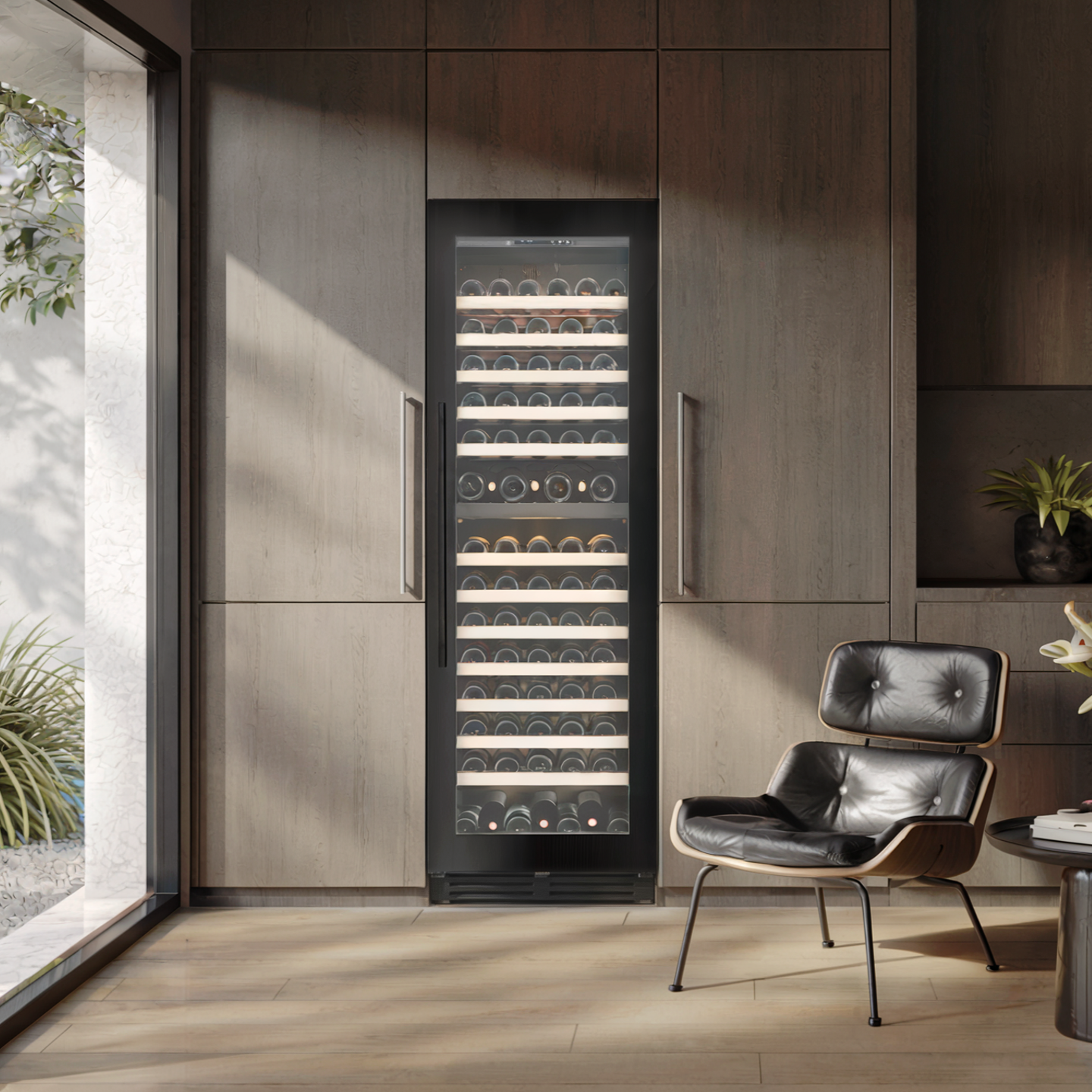
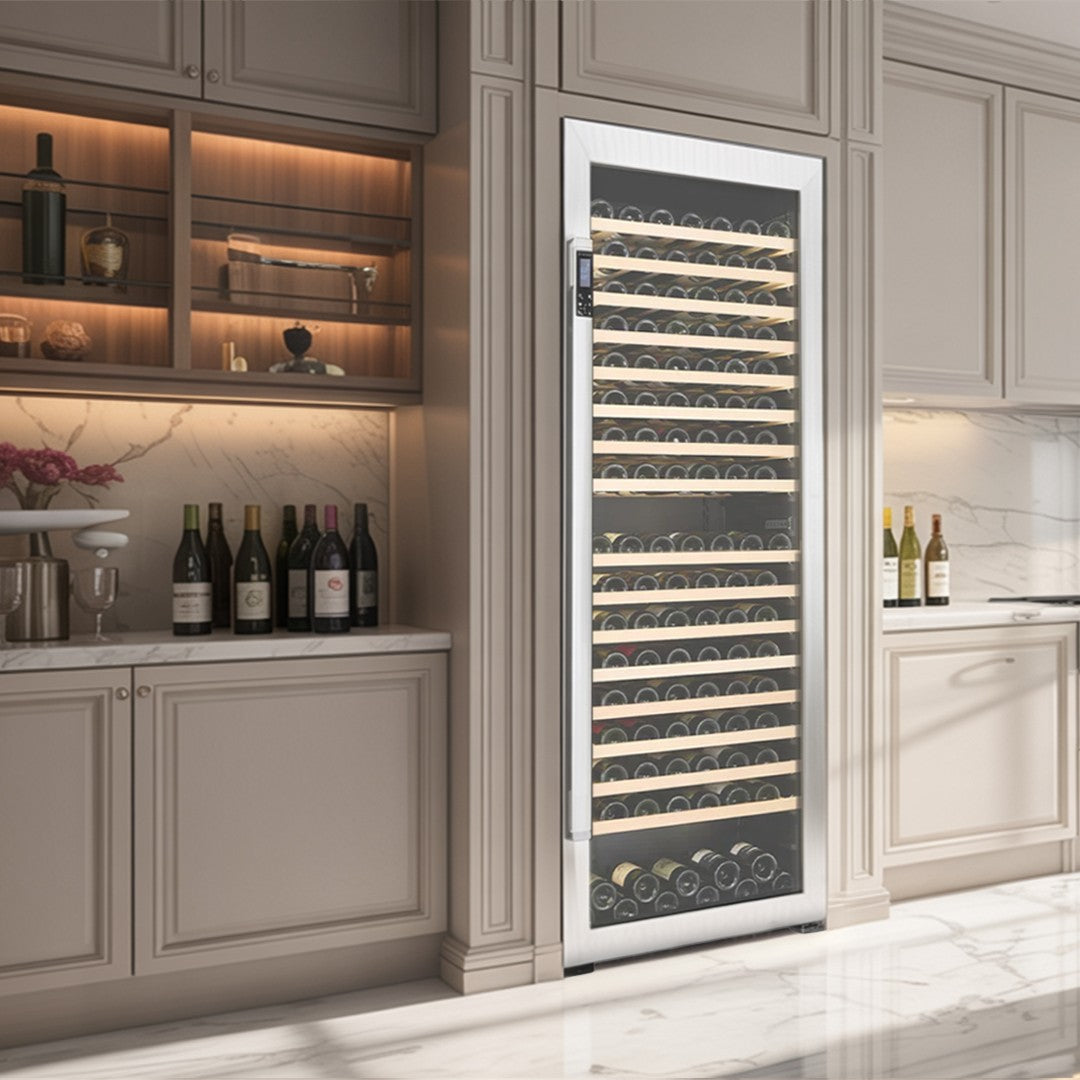
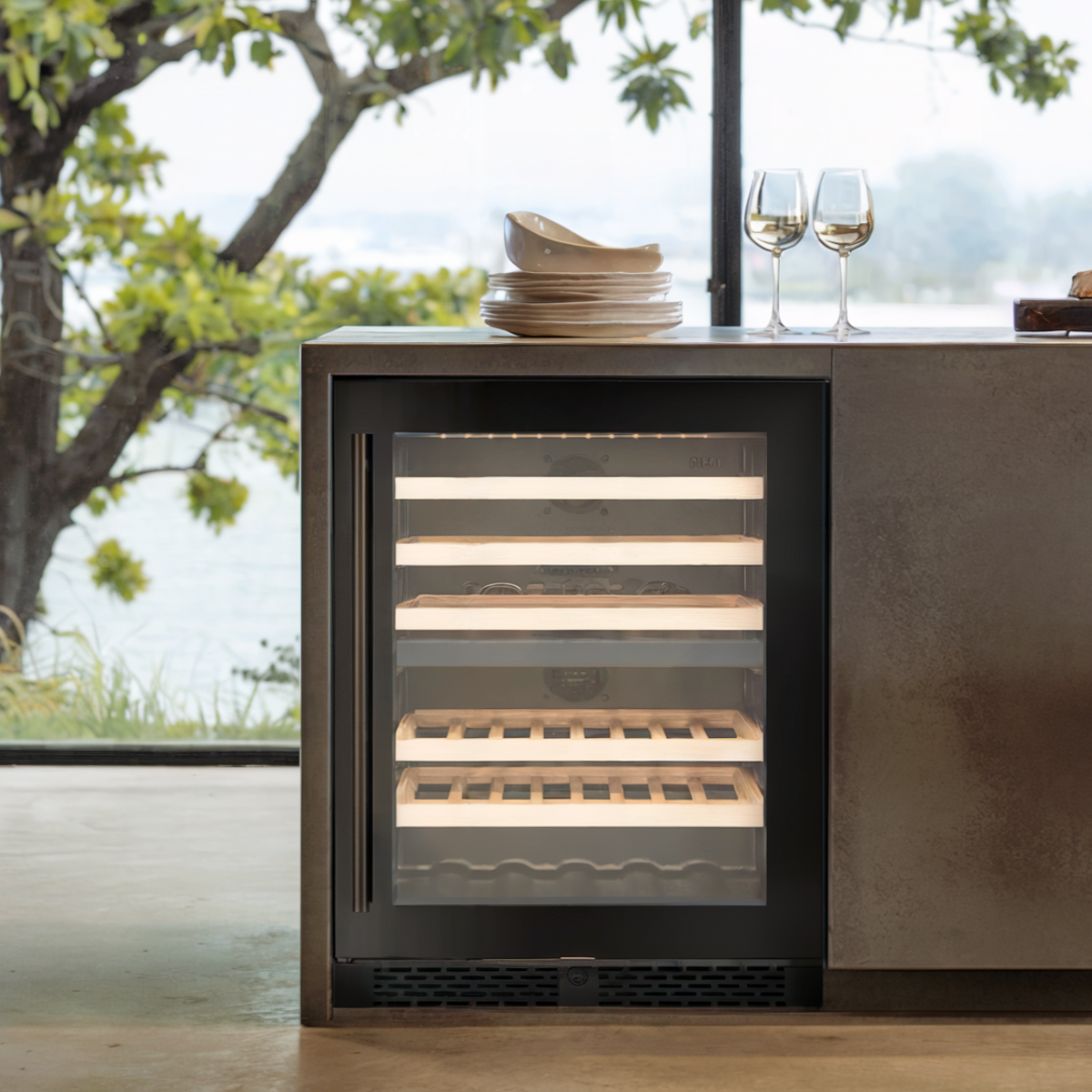
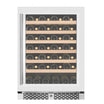
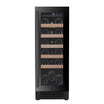
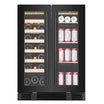
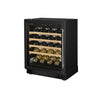
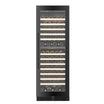
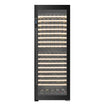
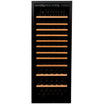
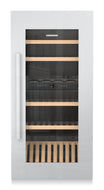
- For a more integrated storage solution, consider how a Vantaggio V300 Wine Cabinet fits your collection and space.
How airflow helps prevent cellar hot spots and temperature spikes
In a wine cellar, conditioned air needs to reach storage areas evenly to limit temperature gradients and localized warm pockets. Good circulation supports more consistent conditions without relying on extra cooling alone.
Temperature Gradients and Warm Pockets
A temperature gradient is a difference in temperature between locations or heights in the same cellar. It matters because bottles in a warmer corner may experience different conditions from those near the cooling unit. Heat rises, so lower shelves may naturally be cooler. A difference of a few degrees between a distant corner and the unit can signal poor airflow in that area.
Hot spots can develop when conditioned air misses parts of the room or racks and other objects block its path. Supply air may also return to the cooling unit too quickly, leaving distant shelves with less circulation. The U.S. Environmental Protection Agency notes that blocked or poorly placed supply and return vents can prevent air from reaching parts of a room.
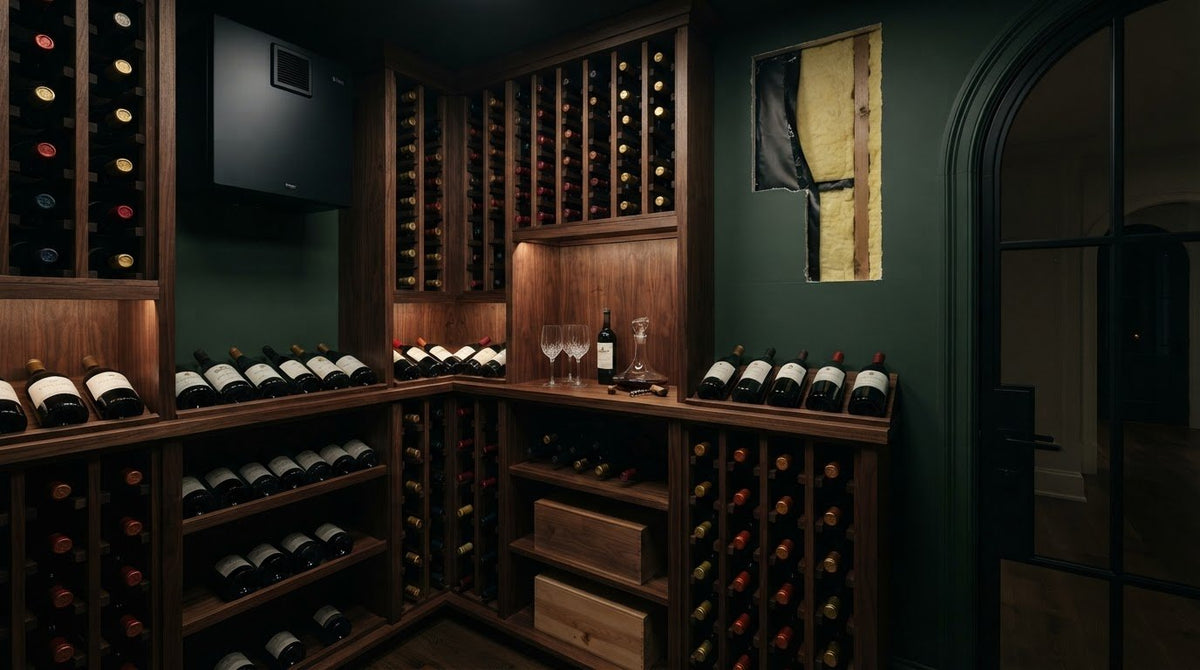
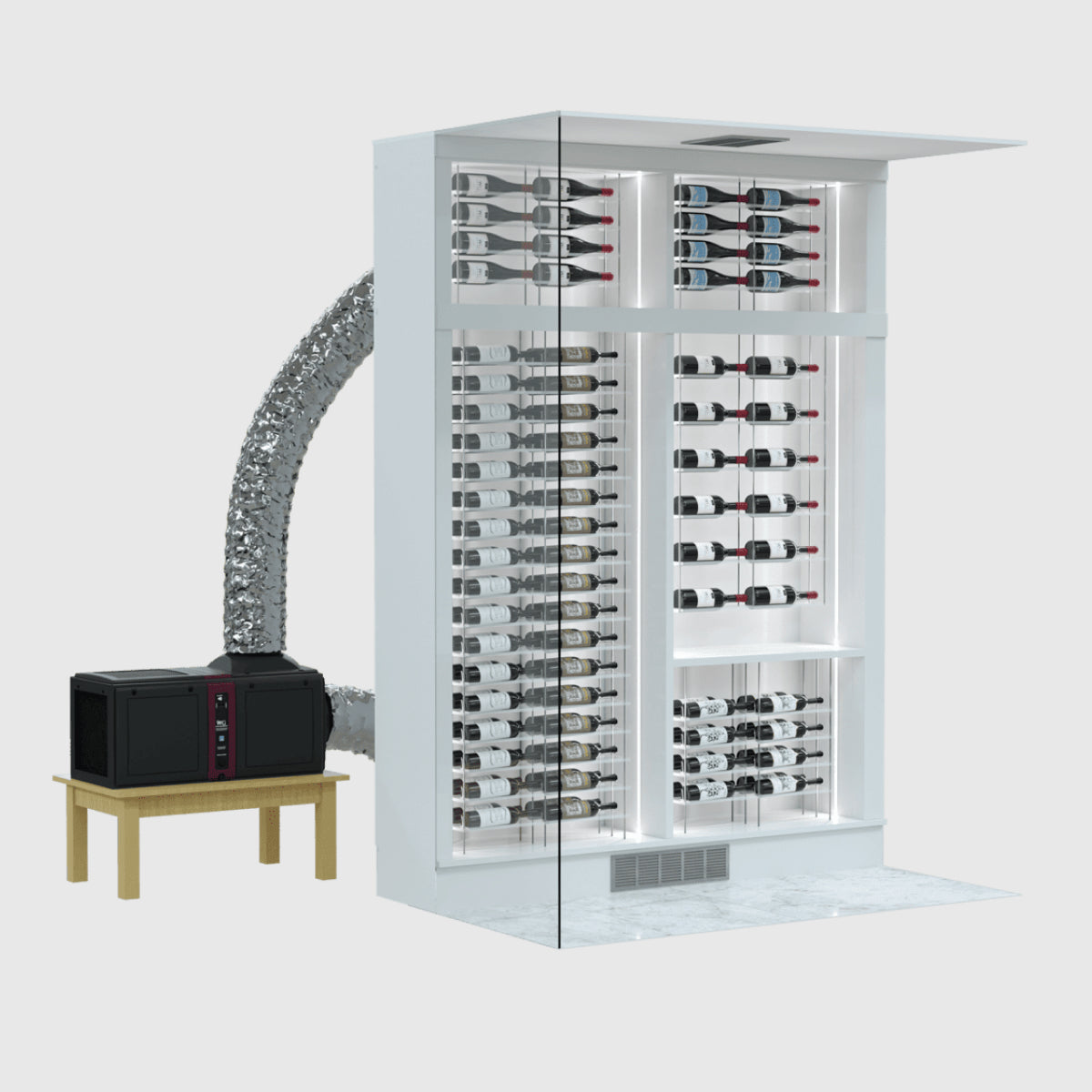
A cooling unit distributes conditioned air through its supply path and draws room air back through its return. The layout should let air travel across storage areas before returning, rather than forming a short loop near the unit. In a large or L-shaped cellar, a small internal circulation fan can help reach areas the cooling unit misses without bringing in outside air. Effective wine room air circulation that eliminates hot spots starts with a complete airflow path.
Mixing also matters in wine tanks, where a mixer can reduce localized warm pockets and improve temperature uniformity. In a cellar, gentle circulation helps limit stagnant areas, but blowing excessive air over corks is not the goal. The aim is to move air through the room, not to create a strong draft over individual bottles.
Monitoring Temperatures at Multiple Heights
Place thermometers at different heights and in separate parts of the cellar to reveal uneven conditions. Compare a reading near the cooling unit with one in a far corner, then check upper and lower storage levels. This makes temperature gradients visible instead of relying on a single reading beside the unit. Use these readings to guide wine room air circulation and eliminate hot spots.
Cellar storage is commonly recommended between 45°F and 55°F, with 55°F described as ideal. Readings above 70°F can accelerate wine aging. If one location is consistently warmer, consider whether a blocked path, vent placement, or room shape prevents air from reaching it, then assess the airflow pattern before changing the cooling setting.
The cost of improving airflow depends on cellar size, cooling capacity, vent changes, and installation complexity. Request a quote for project-specific pricing.
Vent designs for wine rooms and humidors
Vent design affects how conditioned air spreads and where moisture collects. In a wine room, the vent’s direction, material, and distance from the return all matter.
A wine room should generally maintain 45°F to 55°F and 60% to 70% relative humidity. These ranges support wine storage while helping balance temperature and moisture.
Vent Designs and Condensation
A vent design directs supply air into the room while keeping its path distinct from the return. This matters because air that returns to the unit immediately may bypass storage areas. A custom wood register can diffuse airflow in 2 directions, while custom vents can use 3- or 4-way louvers to direct air around the room.
Cold supply air meeting humid room air can create condensation near a vent. When inspecting a damp vent, check 4 or 5 inches back from the duct opening for water or dampness. Wood vents have a different dew point than metal or aluminum vents and are usually better at reducing moisture buildup or dripping from supply vents. Keep vents away from garages, kitchens, and strong odors.
Fan Circulation Without Drying Corks
A fan improves circulation by gently moving cellar air rather than introducing outside air. Use a low, indirect flow and avoid directing excessive air over wine corks. This helps distribute the room’s temperature without creating a drying draft over bottle tops.
Monitor humidity with a hygrometer as well as temperature with a thermometer. Relative humidity below 50% can dry corks and allow oxidation, while a reading above 75% can risk mold growth and label damage. A range between 50% and 70% is described as safe for most wines, making regular readings useful when adjusting fan movement.
Blocked or poorly placed supply and return vents can prevent air from reaching parts of a room, according to the U.S. Environmental Protection Agency. If vent design needs to work around the room’s shape and storage layout, custom wine cellar design can bring those considerations together.
When designing a custom vent, have the HVAC technician convert CFM to Free Air Area. Position a wine-room supply vent so conditioned air does not immediately return to the unit for reconditioning. In a humid wine cellar, circulation can help prevent bacterial growth, and evenly exhausting air from the cellar is recommended for that purpose.
Traditional underground wine cellars may use passive ventilation through simple wall or door vents. The U.S. Environmental Protection Agency says ventilation and shading can help control indoor temperatures.
Space and ventilation requirements around cooling equipment
Cooling equipment needs space for air to move through its supply and return paths. Its exhaust heat must also leave the cellar area instead of recirculating into wine storage.
Cooling-System Types and Ventilation Space
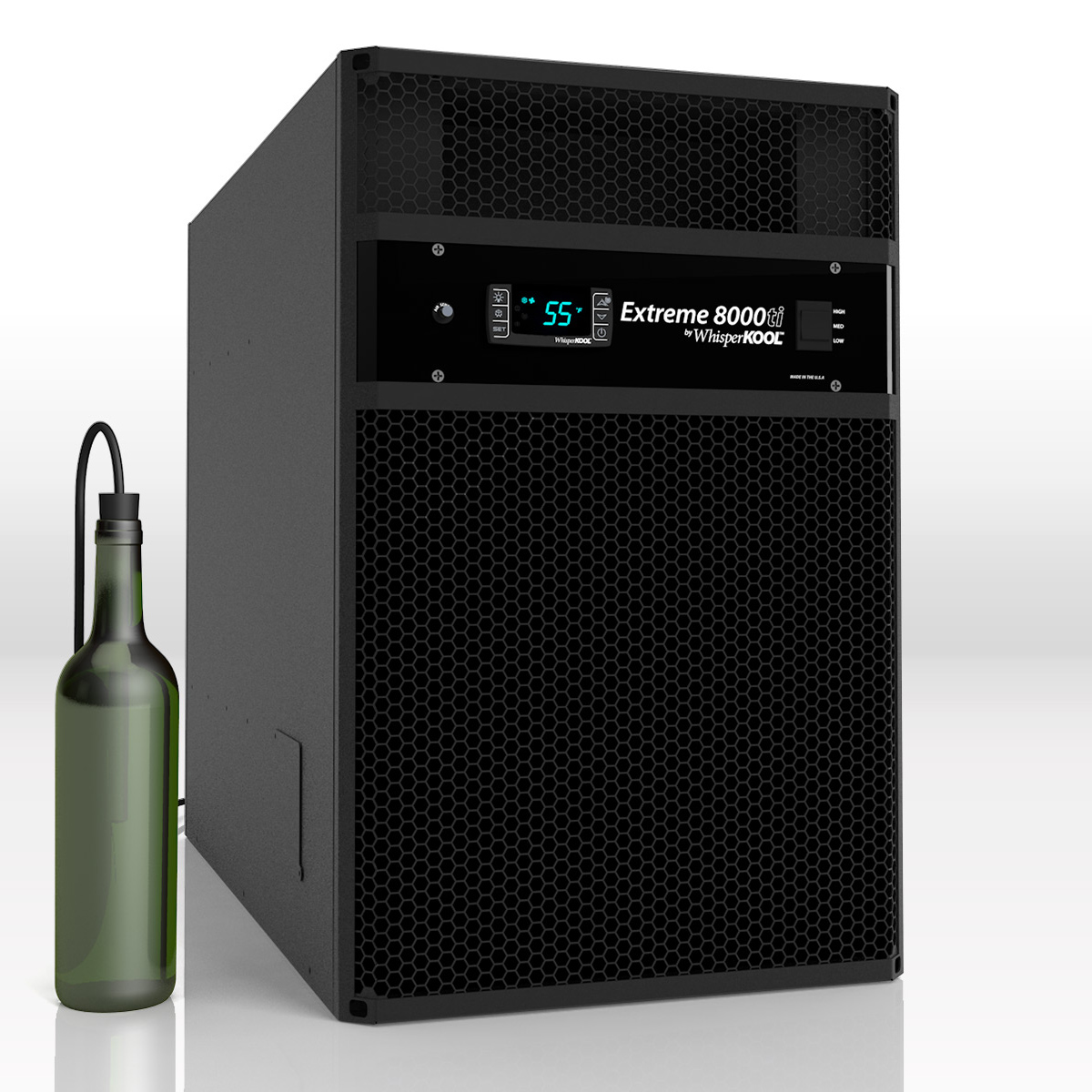
Through-the-wall systems place cooling equipment in a wall opening; split systems separate indoor and outdoor components; fully ducted systems move air through ducts. Each setup needs space for airflow and service access. Follow the installation manual’s clearance requirements, and keep racks and stored items outside those zones.
Cellar volume guides equipment selection. Common size categories include under 500 cubic feet, 500 to 999 cubic feet, 1000 to 1999 cubic feet, and above 2000 cubic feet. These categories help frame capacity decisions, but room shape, insulation, glass, and heat load also affect cooling demand.
Removing Cooling-Unit Exhaust Heat
A cooling unit transfers heat out of the cellar, so its exhaust side needs ventilation to release that heat elsewhere. If exhaust air returns toward the intake, the unit may operate in a warmer environment and work harder. Modern, sealed, or above-ground cellars usually need active ventilation and mechanical cooling, with exhaust heat directed away from the cellar.
Allow for the actual unit and its cover when planning an installation. In one project, a unit extended 4 inches from the wall, so a custom exterior cover preserved ventilation around it. That example shows why an enclosure must leave an open path for exhaust rather than concealing the equipment tightly.
Equipment placement also affects airflow. Keep wine racks clear of supply and return paths, and avoid decorative panels that restrict air movement. A unit that runs constantly may have poor ventilation or be undersized, so persistent operation can indicate an airflow problem or a mismatch in capacity.
Short cycling is different: an oversized unit may cool the nearby area quickly, stop, then restart before conditions even out elsewhere. This repeated pattern can leave distant storage less stable. Room volume, insulation, glazing, and target temperature all affect sizing. Matching capacity to the entire cellar matters more than choosing by floor area alone.
UV-C may be considered as an equipment-cleanliness option, but it does not replace clearances, airflow, or routine maintenance. Its placement must suit the specific unit and treatment area. Keep access clear for filter and grille inspections, and follow the cooling system’s installation and maintenance instructions.
Circulation versus ventilation in a sealed cellar
Internal circulation moves cellar air around; ventilation exchanges indoor air with outdoor air. Keeping these functions distinct helps protect temperature and moisture balance.
Airflow Rates and Air Changes
An airflow rate describes how much air moves through a room, while air changes describe how much room air is exchanged over time. No single rate suits every wine room. Room volume, cooling equipment, sealing, and layout determine the appropriate design. These factors matter because internal circulation and outdoor-air exchange affect cellar conditions differently.
For example, a sealed room with a cooling unit may need gentle internal circulation to distribute conditioned air. A separate ventilation plan addresses fresh-air exchange and odors. In an underground cellar, continuous fresh-air circulation can help remove odors, but excessive ventilation can create drafts and dry the room. The right approach depends on how the cellar is built and cooled.
Think of the design in two parts: first, move room air through storage areas; second, manage any planned exchange with outside air. This distinction helps prevent unnecessary drafts or moisture changes caused by ventilation.
Risks of Household Fans and Standard HVAC
A household fan moves air but does not control cellar temperature or humidity. Its placement and direction matter: a strong stream aimed at bottle corks can create a drying draft, while a fan set to circulate air gently can help reduce stagnant areas. Don’t treat a room fan as a substitute for cooling equipment.
Standard home HVAC is designed to condition living spaces, not automatically to maintain wine-storage conditions. Its supply air, return placement, and operating cycles may not suit a sealed cellar’s layout. Poor placement can leave shelves outside the airflow path, while excessive outside-air exchange can introduce drafts and disrupt moisture balance.
Odors also deserve attention. Fresh air can help remove cellar odors, but vents near garages, kitchens, or other sources of strong smells can draw unwanted odors inside. Since wine may absorb foreign odors through the cap, vent placement should account for the surrounding space as well as airflow.
Monitor temperature and humidity at multiple points after adjusting a fan or ventilation setting. A thermometer and hygrometer can show whether conditions vary by location. If the cellar’s shape, door placement, or cooling layout makes airflow difficult to balance, address those details in its custom wine cellar design plan.
Without a ventilation system, a small fan can provide gentle circulation. Insufficient airflow can allow volatilized alcohol to accumulate as flammable gas.
Wine-room air circulation and dead spots
Dead spots form when airflow fails to reach parts of a cellar, leaving conditions uneven around stored bottles. The goal is to circulate air through the room, not create a strong draft over the collection.
Identifying Dead Spots in Wine Rooms
A dead spot is an area where room air moves too little to distribute the cooling unit’s conditioned air. This matters because a bottle beyond the main airflow path may experience different conditions from one near the unit. Large, L-shaped rooms and tightly arranged racks can interrupt circulation. A small fan can gently move air into an overlooked corner without drawing in outside air.
Room construction also affects hot and cold zones. Insulation slows heat transfer through walls and ceilings, while a vapor barrier helps limit moisture movement through the cellar envelope. Gaps around doors, penetrations, or framing can let warmer air in and change local temperature and humidity. Air leaks can undermine even well-planned circulation, especially near an exterior wall or ceiling.
Troubleshooting Hot and Cold Zones
Troubleshooting starts with comparing readings and tracing the airflow path before changing equipment settings. Temperature patterns can help distinguish a blocked route from a room-wide cooling issue. Record readings at different heights and in a far corner, then compare them with a reading near the unit.
- Check whether racks, bottles, or stored objects block supply or return paths.
- Inspect grilles, filters, and in-cellar fans monthly for dust or blockages.
- Compare upper and lower readings, then note which locations stay warmer or cooler.
- Look for air leaks around doors and penetrations if one perimeter area differs.
- Adjust fan direction to move air gently through the room, away from corks.
After each adjustment, take readings again at the same locations. This gives you a useful comparison instead of relying on a single temperature reading. If the cooling unit runs constantly, poor ventilation or undersizing may be involved. Checking airflow can show whether blocked paths are contributing.
A custom wine-room project placed the supply vent about 3 feet from the return and used 3 ducts to help reduce hot spots. The example shows why vent placement and duct paths should be considered together, rather than judging a room by the unit’s location alone.
For a cellar layout with persistent dead zones, explore cellar layout options that account for storage, vents, and circulation paths.
Rosehill Wine Cellars: Vantaggio V300 Wine Cabinet
Rosehill Wine Cellars offers the Vantaggio V300 Wine Cabinet as an option for collections better suited to cabinet storage than a dedicated cellar. For a room-based collection, Wine Cooling Units and custom wine cellar design can help bring cooling needs and room layout into the same plan.
Racking also matters. Premier Cru Classic Racking and Premier Cru Modern Racking are options to consider when planning storage around airflow paths. The right choice depends on whether you need a cabinet, a cooling system, or a cellar layout designed for your space and collection.
Contact Rosehill Wine Cellars to discuss your wine storage plans, or visit rosehillwinecellars.com.
Make Your Cellar’s Next Step Count
Turn your observations into clear design priorities. Note which areas feel less consistent, how your storage layout may affect airflow, and whether a cellar or cabinet would better suit your collection. These decisions can guide wine room air circulation that eliminates hot spots while keeping the space suited to your home and collection.
Rosehill Wine Cellars offers the Vantaggio V300 Wine Cabinet, Premier Cru Classic Racking, and Premier Cru Modern Racking. These options can help frame a conversation about the right storage direction, whether you’re refining an existing cellar or planning a new one.
Contact Rosehill Wine Cellars to discuss your wine-storage plans and explore a considered next step for your space.
Frequently Asked Questions
Need Customized Air Flow?
Customized airflow can help when a cellar’s shape, shelving, or equipment placement leaves areas outside the cooling unit’s natural air path. An L-shaped room or a deep rack wall, for example, may need a different vent direction or additional duct paths than an open, rectangular room. Note where temperature readings vary, then compare those areas with vents, returns, and obstructions. This can help identify whether layout changes or gentle internal circulation could address the issue.
When should I call a professional?
Contact a wine cellar cooling professional if temperature differences persist after you clear blocked grilles and move obstructions. Persistent operation, condensation near a vent, or repeated uneven readings can point to equipment, duct, or installation issues. A professional can assess cooling capacity, airflow paths, and the room envelope as a connected system. Mechanical cooling systems should also receive professional inspections annually to help identify developing problems before they affect storage conditions.
How should wine cellar supply and return vents be positioned for even airflow?
Position supply and return vents so conditioned air travels through the storage area before returning to the unit. Avoid placing them so close together that supply air flows directly into the return, leaving distant shelves with limited circulation. Direct supply air across open room space, not straight onto corks or a rack face. In a custom layout, directional louvers can steer air around architectural features and keep supply and return paths distinct.
How do ducted and ductless wine cellar cooling systems compare for temperature uniformity?
Ducted systems can deliver conditioned air to multiple parts of a cellar, which can help with rooms that have separate storage zones. How evenly they work depends on duct placement and clear, appropriately arranged supply and return paths. A ductless unit delivers air from its location, so room shape and the path across the cellar matter. In either setup, blocked airflow or a short path back to the return can reduce even distribution.
How can you measure and map temperature differences throughout a wine room?
Use a thermometer at several locations and heights, and record each reading on a simple cellar sketch. Include a point near the cooling unit, a far corner, and upper and lower storage levels. Take readings under similar operating conditions for a useful comparison. Mark locations that repeatedly differ, along with nearby vents, doors, and obstructions. A hygrometer can add humidity readings to the map and help distinguish temperature patterns from moisture-related concerns.